Habits and tracking
How to build an exercise habit after 40 that lasts
Attach a short, simple session to something you already do every day, such as the morning kettle, and repeat it on that cue until starting takes no thought. Expect about ten weeks of deliberate effort before it feels automatic, and aim for four short bouts of movement a week while it forms.

Psychologists use the word habit in a narrow sense. A habit is an action your surroundings start for you: you get into the car and the seatbelt goes on without a decision. Researchers at University College London define it as an action "triggered automatically in response to contextual cues that have been associated with their performance" (Gardner, Lally and Wardle, British Journal of General Practice, 2012). That definition changes what you are trying to build. You cannot make a 30-minute strength session effortless, but you can make starting it automatic, and starting is where most routines fail.
This page is about the mechanics of setting up that cue. If your problem is the tired, flat days once a routine exists, our piece on staying motivated through menopause covers those.
How long does it take to form an exercise habit?
Plan for two to three months. In the study behind the often-quoted 66 days, volunteers repeated one healthy action once a day after the same cue, and the sense of automaticity rose quickly at first, then levelled off after an average of 66 days, with wide variation between people. Gardner's summary of that study adds that simple actions such as drinking a glass of water became automatic faster than "doing 50 sit-ups". Gardner and colleagues tell patients to expect around ten weeks, and say the "21 days" figure traces back to anecdotes about plastic surgery patients getting used to their new faces.
A study of exercise itself followed 111 new gym members for 12 weeks (Kaushal and Rhodes, Journal of Behavioral Medicine, 2015). Exercising at least four times a week for six weeks was the minimum the authors found for an exercise habit to form. Four things predicted a stronger habit over time: doing it consistently, keeping it simple, having the right surroundings, and enjoying it.
That frequency matters for anyone starting strength work. The NHS guidelines recommend strengthening activities on two days a week. That is enough for muscle, but going by the gym study it may be too few sessions for the routine to settle quickly. Two strength sessions plus two short walks on the same cue gives you four bouts a week while the habit forms.
Habit stacking for exercise: link it to something you already do
Habit stacking means hanging a new action on one you already do without thinking. Gardner's team put it plainly: a cue inside an existing daily routine, such as "when I go on my lunch break", gives a stable starting point. The cue can be a time of day or an event, as long as it comes round often and at a predictable point in your day.
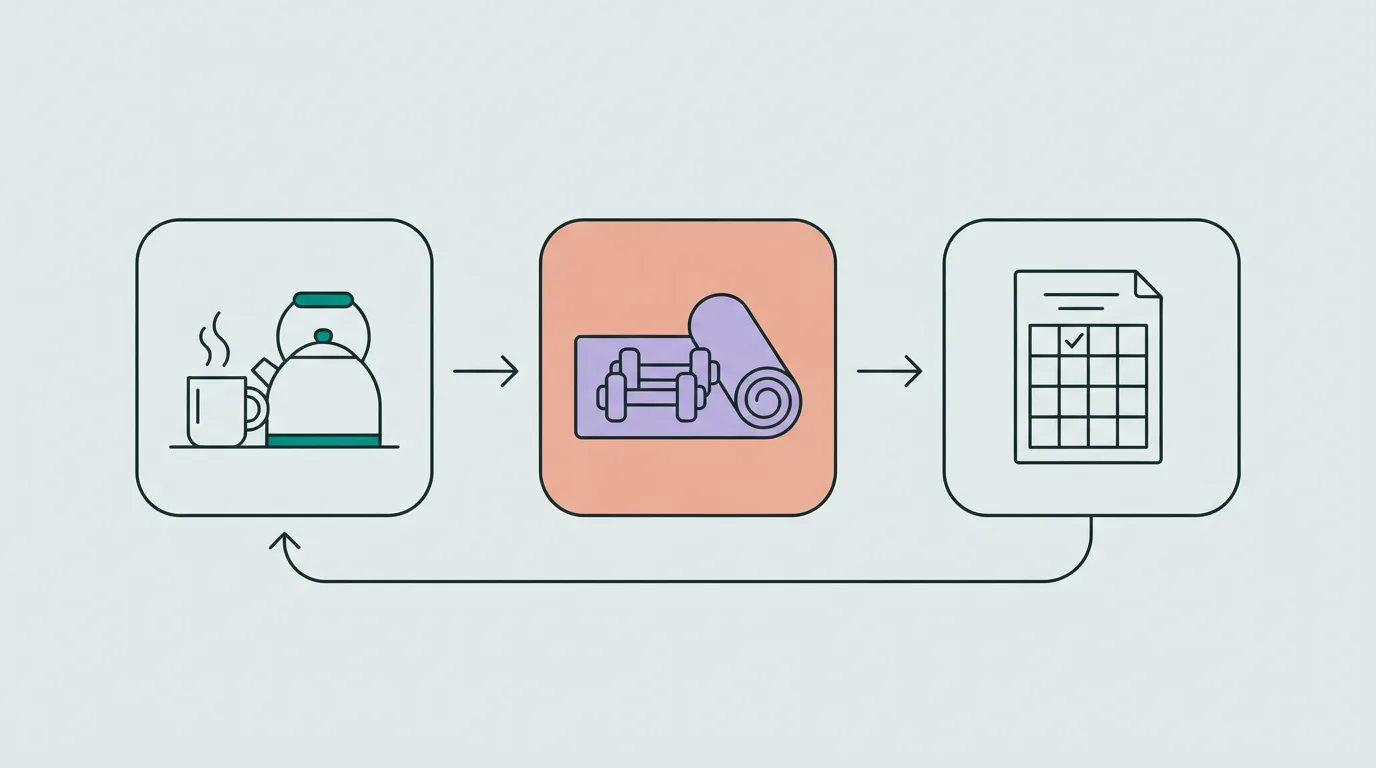
Good anchors for a midlife week:
- The first cup of tea or coffee, with the dumbbells kept next to the kettle.
- Getting home from work, before you sit down or change out of your shoes.
- After you drop someone at school or the station, on the walk back.
- After brushing your teeth in the evening, for a short set of chair stands.
Choose an anchor that still happens after a bad night. If night sweats regularly wreck your sleep, a 6am alarm is a fragile cue, while the morning kettle happens whatever the night was like. Put the equipment where the cue happens, because a band in a drawer upstairs adds a decision you were trying to remove.
Write the plan as an if/then sentence, with a plan B
Psychologists call a sentence like "If it is Monday and I have boiled the kettle, then I do my squats" an implementation intention. A review of 26 studies found these plans raised physical activity by a small to medium amount, both straight after the intervention and at follow-up (Bélanger-Gravel and colleagues, Health Psychology Review, 2013). The plans worked better when they included what the authors called barrier management: a second line for the thing most likely to stop you.
So write two lines for each slot. The first is the normal plan. The second names your usual obstacle and what you do instead:
- "If it is Thursday and I get home from work, then I do my six moves before I sit down."
- "If I slept badly, then I do the seated version for ten minutes instead."
The second line keeps the cue and the action paired on the days the full session will not happen. Our strength week planner helps you place the two strength slots away from the nights you tend to sleep worst.
Keep the routine small and the same
Most fitness advice pushes variety to stop you getting bored. For forming a habit, Gardner's team argue the opposite: variation takes effort and depends on motivation, and it works against automaticity. Repeat the same short routine, in the same order, in the same place.
For a beginner that could be the six moves in our home workout for women over 50, done in the same sequence each time. Make progress by changing the load, not the routine: add a rep, then a set, then a heavier pair of dumbbells. Our guide to sets and reps for beginners explains when to move up, and the dumbbell weight finder gives you a starting weight per move.
Start smaller than feels worthwhile. Gardner's example for a sedentary patient is to walk one or two stops further before getting on the bus. A first habit of ten minutes that happens every time is worth more than a 45-minute plan that happens twice.
Exercise consistency tips for the first ten weeks
Tick it off. The UCL paper includes a simple sheet for patients: a tick for each day the action was done, and once a week a score from 1 to 10 for how automatic it feels. Watching that score climb is evidence the effort will not last forever. Our printable workout and symptom log has room for the ticks next to your sleep and symptoms.
Judge the week by the slots kept. In the first ten weeks the result that counts is whether the cue led to the action. How heavy the session was matters later.
Go back at the next cue after a miss. In the 66-day study one missed day did not set the process back in any lasting way. Waiting for a fresh Monday turns one gap into several. After a longer break, our guide to restarting strength training after time off sets the weights for the first weeks back.
Pick something you can stand. Enjoyment was one of the four predictors in the gym study. If you dislike the gym floor, bands at home or a weekly class on a fixed day count just as well.
Measure your strength. Repeat the 30-second chair stand test at week one and week ten. A higher count is a reason to keep the slot that does not depend on how you feel that morning.
A sample week while the habit forms
Here is one way to reach four bouts with two strength days, each one tied to a moment most people have in their week:
- Monday, after the morning kettle: strength routine, about 20 minutes.
- Tuesday, after lunch: a brisk ten-minute walk (our walking guide explains what brisk means).
- Thursday, on getting home: strength routine.
- Saturday, after breakfast: a longer walk.
Swap the days to suit your week, but keep each one tied to the same cue every week. If you want to see how this adds up against the 150 weekly minutes of moderate activity, our weekly exercise checker totals it for you.
My take
I would start with one anchor and one small routine, written as two if/then lines on a card stuck by the kettle. I would add walks on a second anchor to reach four bouts a week, and I would not change the routine for the first ten weeks, only the weights. The weekly automaticity score is the number I would watch, since it tells you when the effort of starting is fading. Once starting feels routine, that is the time to make the sessions longer or harder.
Before you start
If you have not exercised for years, or you live with a heart condition, high blood pressure, joint problems or low bone density, our pre-exercise health check lists the situations where a word with your GP comes first.