Strength training
Sets and reps for beginners over 40
Start with two sets of 8 to 12 repetitions of each exercise, using a weight that makes the last two or three repetitions hard but still tidy. When you can do 12 on every set, move to a slightly heavier weight and drop back to 8.
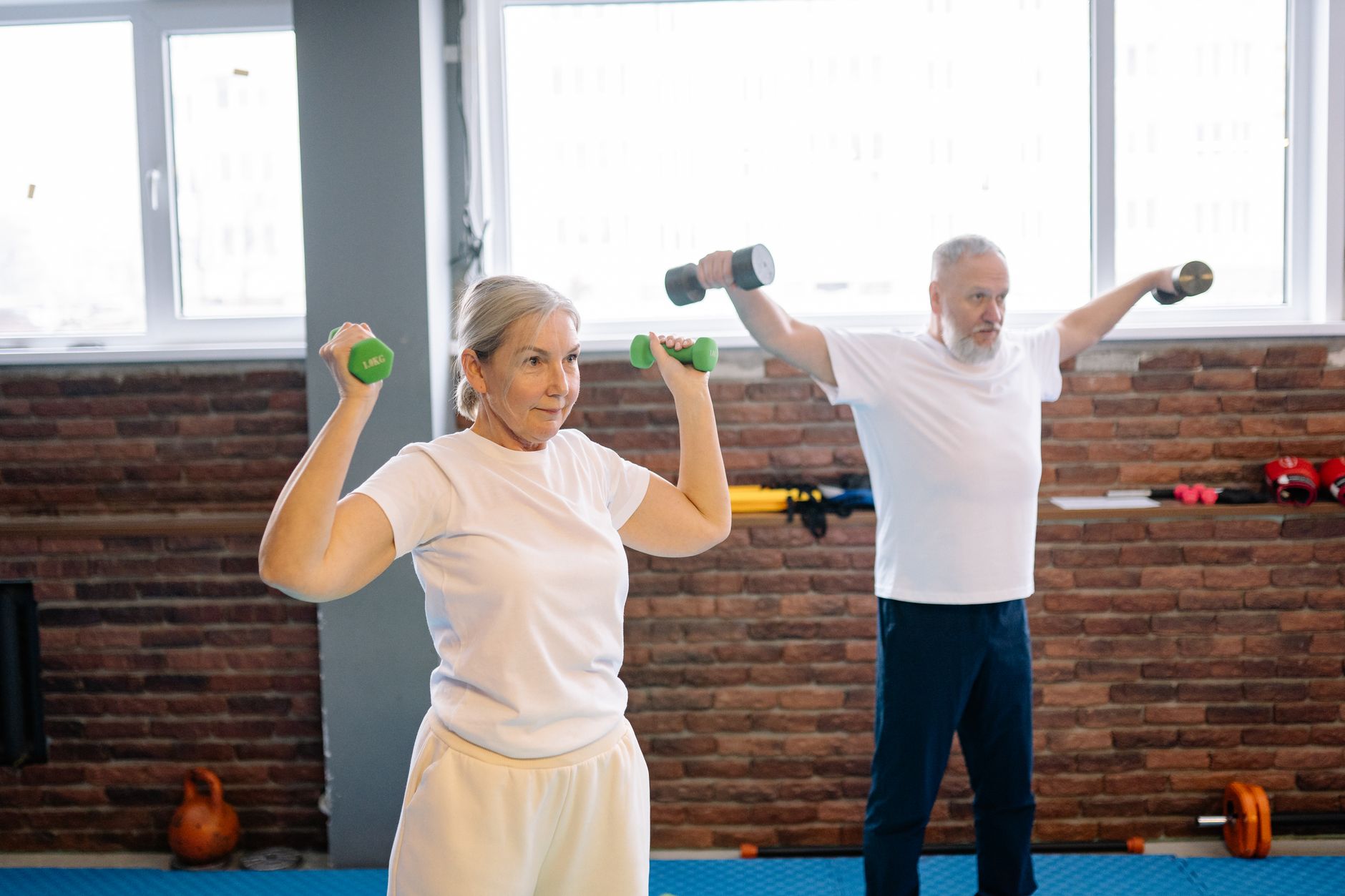
That one rule covers most of what a beginner needs to know about how many sets and reps to do. The rest of this page explains where the numbers come from, how heavy your weights should be in the first weeks, and how progressive overload works in practice once the starting weight feels easy. If your question is how much strength work a longer life calls for, cohort studies point to about 30 to 60 minutes a week, which two sessions of these sets fill, as the section on longevity shows.
What a rep and a set are
A repetition, or rep, is one complete movement: you stand up from a chair once, or lift a dumbbell to your shoulder and lower it again. A set is a run of repetitions done one after another without a break. "2 sets of 10" means ten squats, a rest of a minute or two, then ten more. Our 4-week strength plan writes the same thing as "2 × 10".
How many reps: the NHS rule
The NHS puts the target in terms of effort. Do each exercise until you reach the point where another repetition would be difficult without help, and count 8 to 12 repetitions as one set (NHS, How to improve your strength and flexibility). The number of reps follows from the weight you choose. If you can do 20 before it gets hard, the weight is too light to count as a set in this sense. If you cannot reach 8 with good form, it is too heavy for now.
The American College of Sports Medicine reached the same range for people new to lifting. Its 2009 position stand on progression recommends loads that you can lift 8 to 12 times for novices (ACSM, Progression models in resistance training for healthy adults, 2009). The same stand gives sets of more than 15 with lighter weights a separate job, building muscular endurance, and our six-week muscular endurance plan uses that range once the first months of 8 to 12 are behind you.
How many sets
The NHS asks for at least two sets of each exercise, and three if you want more benefit. The US National Institute on Aging is gentler at the start: one set of 8 to 12 repetitions already works, and two or three may work better (NIA, Three types of exercise). In the first fortnight, one set of each move is a reasonable way in. Add the second set once you know the moves and are not sore for days afterwards.
Rest between sets long enough to do the next one well. The National Strength and Conditioning Association's statement on older adults suggests about two minutes (Fragala and colleagues, NSCA position statement, 2019), which is also roughly the time it takes to switch to a different exercise and come back.
The guidance side by side
| Source | What it recommends |
|---|---|
| NHS | 8 to 12 reps to the point where another would be hard without help, at least 2 sets, 3 for more benefit, on 2 or more days a week |
| NIA | 1 set of 8 to 12 reps works, 2 or 3 may be better, never the same muscles two days running |
| ACSM 2009 | Loads you can lift 8 to 12 times for novices, with 2 to 10% more load once you pass your target by 1 or 2 reps |
| NSCA 2019 | 2 or 3 sets per muscle group, 10 to 15 reps for beginners, about 2 minutes of rest, no need to train to failure |
How much strength training for a longer life
The clearest answer on minutes comes from a 2022 meta-analysis in the British Journal of Sports Medicine that pooled 16 long-running cohort studies of adults. People who did about 30 to 60 minutes of muscle-strengthening activity a week had roughly a 10 to 20% lower risk of dying from any cause, from heart disease and from cancer over the follow-up, and that held after taking their aerobic exercise into account (Momma and colleagues, British Journal of Sports Medicine, 2022). That range is the sweet spot people search for.
Past an hour, the curve bends back up into a J shape. The authors found no clear sign that more strength work lowered the risk further, and they describe the effect of higher volumes as unclear. Read that as "more did not show extra benefit in these data", which is a different thing from more being harmful. Someone who enjoys three hours a week in the gym has no reason from this study to stop.
The limits are worth knowing before you plan around a number. Every study in the pool was observational, so it shows who lived longer, not what caused it. People reported their own strength training on questionnaires, only a few studies fed each result, and most were run in the US (News-Medical summary of the paper's limitations). The same summary reports the largest drops in people who combined strength work with aerobic activity, which is why the NHS asks for both.
What 30 to 60 minutes looks like in sets
The studies counted minutes and never sets, so this is arithmetic, not a finding. Two sets of 8 to 12 reps take under a minute each, and with about two minutes of rest after each set, one exercise fills roughly five minutes. Five or six exercises make a session of 25 to 30 minutes, so two sessions a week land inside the 30 to 60 minute range. If you would rather keep sessions short, three sessions of three or four moves add up to much the same. Our 4-week strength plan builds to that volume from one set, and the strength week planner picks which days to train.
How heavy should weights be for beginners
Heavy enough that the last couple of reps slow down, and light enough that your form does not change to get them up. A practical test is to count how many more good reps you think you could have done when you stop. Coaches call this reps in reserve. A 2016 paper set out the scale used in research, where stopping with two left in the tank is a 2 and stopping because nothing more will move is a 0 (Zourdos and colleagues, Journal of Strength and Conditioning Research, 2016).
For a beginner, two or three in reserve is a sensible place to finish a set. One thing to know about guessing: a study of adults with an average age of 68 found they tended to stop with about two more reps left than they thought they had, when aiming for two in reserve (Validity of repetitions in reserve for prescribing resistance exercise in older adults). If a set feels hard at rep 10, it is probably a little less hard than it feels, and that is a fine margin while you learn.
Going all the way to failure is not needed. The NSCA statement notes that training to failure has not been shown to bring extra gains in older adults. The NIA adds that beginners can learn a move with no weight at all first, and warm up with a lighter weight before the working sets. Expect your legs to need more weight than your arms, and treat the right weight as the one that passes the test above, whatever it says on the handle. To turn one test set per move into a starting size, use the dumbbell weight finder.
Progressive overload explained
Progressive overload means asking your muscles for slightly more than they managed last time, a little at a time, so they keep adapting. The ACSM position stand calls it the foremost principle of getting stronger, and gives a simple trigger: when you can do one or two reps more than your target with your current weight, raise the load by 2 to 10%. Strength coaches often shorten this to a "2-for-2" habit, waiting until you beat the target by two reps in two sessions in a row before you step up. To apply either rule to your own log, the progression calculator says whether to add, keep or drop and rounds the answer to a real dumbbell or machine step. Overload is one of seven rules of training, and the guide to the principles of exercise and the FITT principle shows how it works alongside specificity, recovery and the others.
With home dumbbells that 2 to 10% is hard to hit exactly, because the jump from 3 kg to 4 kg is a third more weight. So the usual way to do it is called double progression. You keep the weight the same and add reps session by session, from 8 towards 12. When every set reaches 12 with good form, you pick up the next weight, which drops you back to around 8 reps, and you climb again.
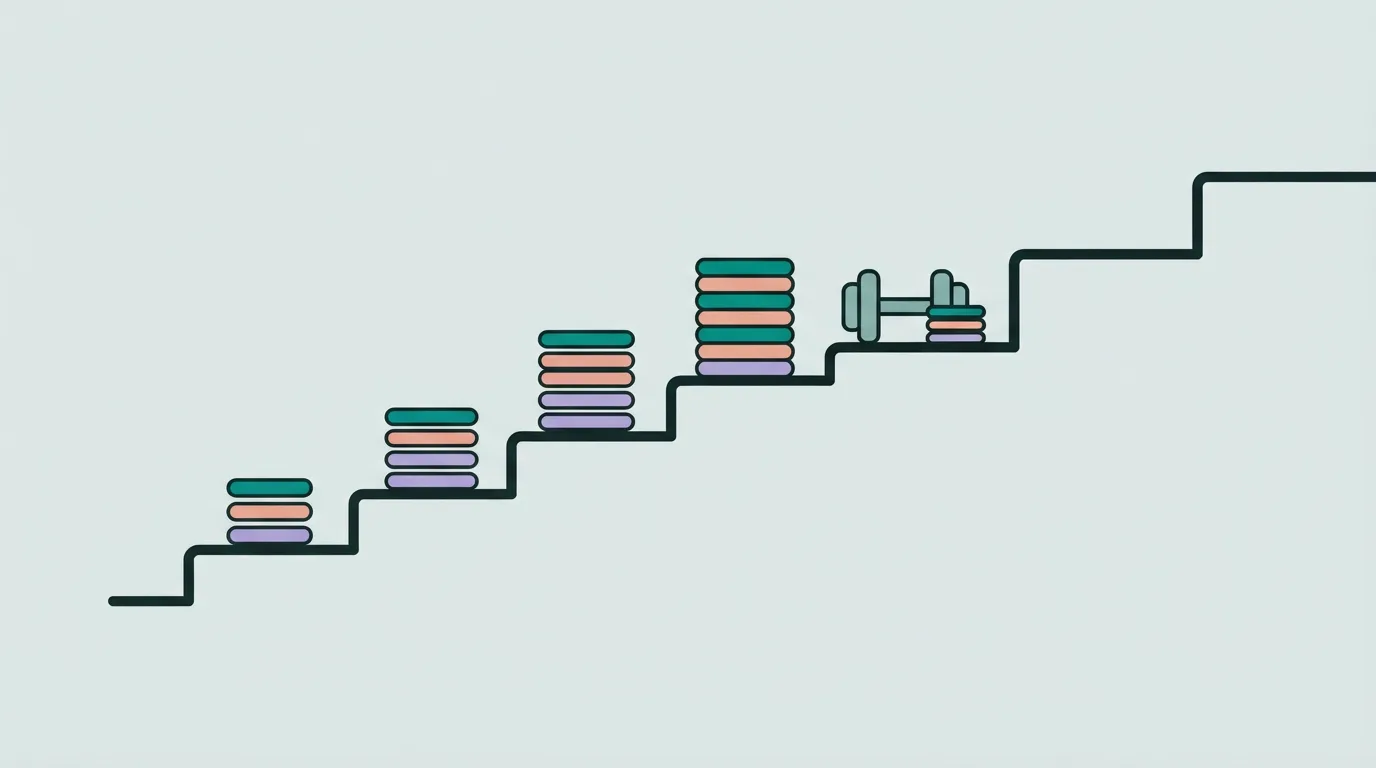
Weight is only one lever. The NIA lists more weight, more sets, more repetitions or an extra day of training as the ways to keep improving. Change one of them at a time, so that when a session goes badly you know what caused it. If the next dumbbell is too big a jump, add a third set first, or slow each rep down so it takes three seconds to lower.
How many reps to build muscle for women over 50
The same 8 to 12 range works, and the research does not single out women over 50 for a different number. The NSCA statement suggests 10 to 15 reps for beginners, which lets you learn a move at a lighter load, and 6 to 12 later on for strength. What builds muscle is the combination of effort, sets and time: sets that end close to hard, done on two or more days a week, kept up over months. After menopause that matters more than usual, because women tend to lose muscle in these years, as our article on whether menopause causes weight gain explains. Eating enough protein after menopause helps the training do its work.
How to log your sessions
You cannot add a rep you did not write down. A notebook works, and so does the notes app on your phone. For each exercise, record:
- the date and the exercise, such as "goblet squat"
- the weight in each hand, or "bodyweight"
- the reps in each set, such as "10, 9"
- how many good reps you think were left at the end, or a word on how it felt
Before the next session, read the last line for each move and decide what to beat: one more rep on the second set, or the same reps with a heavier dumbbell. After a month the log also shows you something a mirror cannot, which is that a weight that stopped you at 8 now goes for 12.
What I would do in the first eight weeks
I would pick five or six moves that cover the legs, the back, the chest and the shoulders, such as the ones in our guide to starting strength training in menopause, and train them on two days a week with at least one rest day between. To choose those two days around poor nights and symptom days, the strength week planner places them for you. For the first two weeks, one set of each at a weight that leaves three reps in reserve. From week three, two sets. Each time every set reaches 12, go up a size for that move alone. If you have no weights yet, the home workout for women over 50 uses the same rules with chairs, walls and bottles.
If you have been told your bone density is low, the same counting applies, with technique ahead of load. Our page on exercise with osteoporosis covers which moves to adapt.
When to ease off
Muscle soreness a day or two after a new session is normal, and the guide to sore muscles after 40 covers how long it lasts and whether to train through it. Sharp pain during a lift, or pain in a joint that lasts, is a reason to stop that move and get it looked at. The NHS suggests talking to a GP before starting if you have not exercised for a long time or live with a health condition.