How far, how fast, and where lifting fits
Walking for weight and fitness after 50
Brisk walking, at about 3 miles an hour or roughly 100 steps a minute, counts towards the 150 weekly minutes of activity adults are advised to do, and in trials it trims weight, body fat and the deep fat around the organs. It does not load your muscles hard enough to keep them, so after menopause it works best next to two short strength sessions a week.
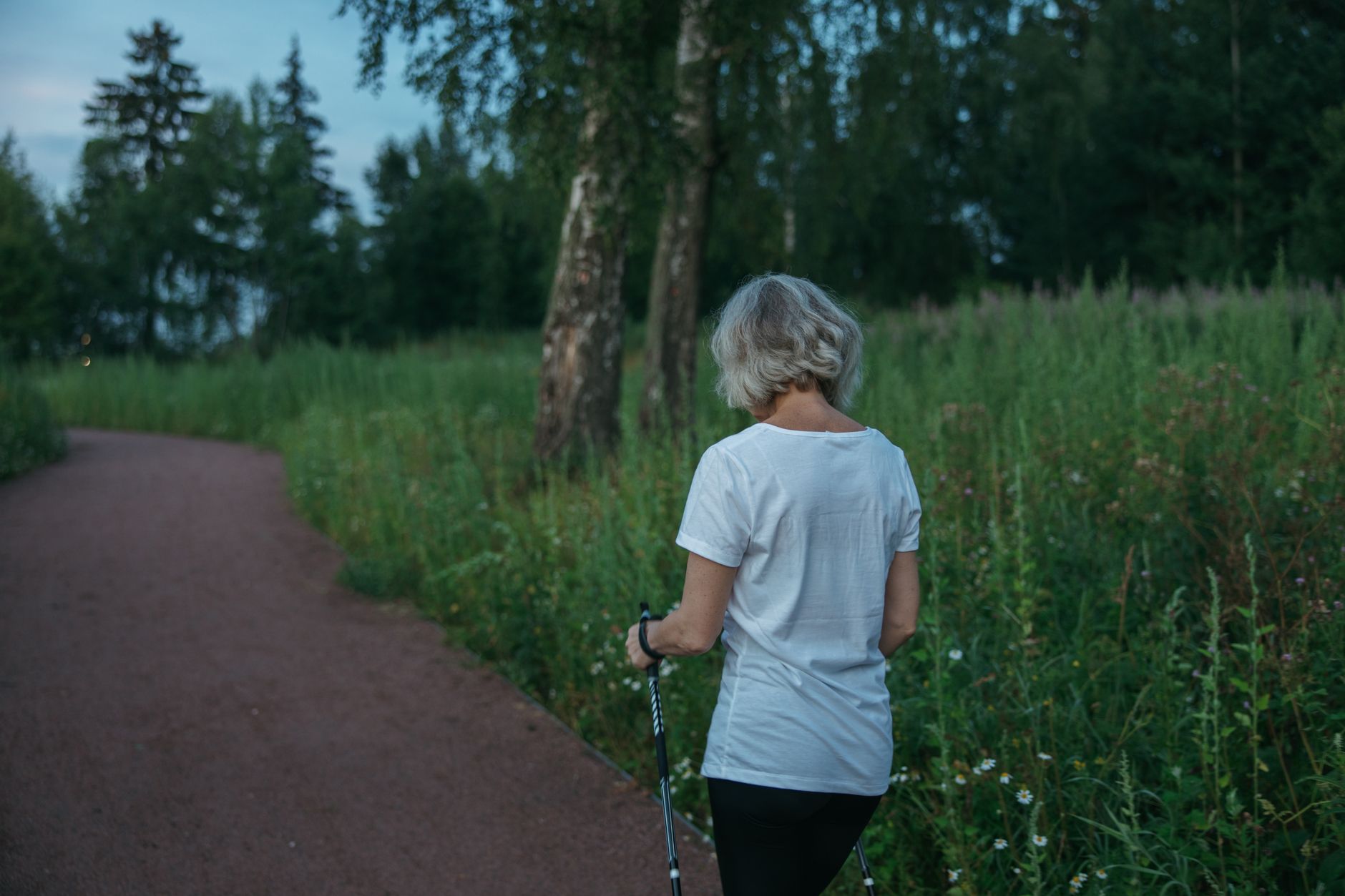
Walking is where a lot of women start when the waistband gets tighter in their fifties, and it is a good place to start. It needs no kit beyond comfortable shoes, it fits around work and family, and it is easy on joints that complain about running. The questions that follow are practical ones: how fast, how far, whether it shifts weight, and whether it is enough on its own. This page answers each from the guidelines and the studies behind them.
Is walking enough exercise after menopause?
For your heart and lungs, it can be. The NHS physical activity guidelines ask adults for 150 minutes of moderate activity a week, and its walking for health page says a brisk ten-minute daily walk counts towards those minutes. The US guidelines set the same floor and say that going up to 300 minutes brings more benefit (ODPHP, Physical Activity Guidelines for Americans).
Both sets of guidelines add a second, separate target: activities that strengthen the major muscles on at least two days a week. The NHS is explicit that this time is on top of the 150 minutes. Walking fills the first target and leaves the second one empty, which matters more after menopause than at any earlier point, for reasons covered further down.
Brisk walking pace: how fast is fast enough?
The NHS puts a brisk walk at about 3 miles an hour, faster than a stroll. Its quick check is the talk test: you are walking briskly if you can still talk but cannot sing the words to a song. If you can only manage a few words between breaths, you have tipped into vigorous effort, which counts double in the guidelines.
Counting steps gives you a number to aim for. In the CADENCE-Adults study, 98 healthy adults aged 61 to 85 walked on a treadmill at rising speeds while researchers measured the oxygen they used. A cadence of 100 steps a minute matched moderate intensity, the same threshold earlier work had found in adults aged 21 to 60 (Tudor-Locke and colleagues, International Journal of Behavioral Nutrition and Physical Activity, 2021). A follow-up in the same group looked at effort relative to each person's own heart rate and sense of exertion, and put the best single threshold at 105 steps a minute (McAvoy and colleagues, 2023).
To use that on a walk, count your steps for 15 seconds and multiply by four. Twenty-five steps in 15 seconds is 100 a minute. If you land well below that and the talk test says you could sing, lengthen your stride a little and swing your arms. The NHS also points to its free Active 10 app, which tells you when your pace is brisk.
How many steps a day for women over 50?
The best evidence on daily steps comes from a pooled analysis of 15 studies that followed 47,471 adults on four continents for a median of seven years (Paluch and colleagues, Lancet Public Health, 2022). People in the lowest quarter averaged about 3,550 steps a day. Compared with them, the risk of dying during follow-up was 40% lower in the next quarter (about 5,800 steps), 45% lower around 7,800 steps and 53% lower around 10,900 steps.
Age changed where the benefit levelled off. For adults aged 60 and over, risk kept falling up to about 6,000 to 8,000 steps a day and then flattened. For those under 60, the curve flattened at 8,000 to 10,000. The authors start their paper by noting how little evidence there was behind the popular 10,000. Once total steps were taken into account, how fast people walked mattered less than how much they walked.
So for a woman in her fifties, 8,000 steps is a sound target, and in her sixties, 6,000 to 8,000. If you sit near 3,000 today, the first 2,000 extra steps sit on the steepest part of the curve. These are observational links with death from any cause, not trial results for weight, so treat the numbers as a guide to how much daily movement is worth having.
Walking for weight loss: what to expect
Walking does move the scale, by a modest amount. A meta-analysis of 24 randomised trials found that sedentary adults who took up regular brisk walking lost body weight and body fat and lowered their BMI, along with gains in aerobic fitness and a drop in diastolic blood pressure (Murphy and colleagues, Preventive Medicine, 2007).
For women past menopause the clearest numbers come from a Canadian trial of 320 inactive women aged 50 to 74. They were asked to do 45 minutes of aerobic exercise five days a week for a year without changing what they ate, and they averaged just under three hours a week. Against the control group they lost about 1.8 kg of weight and 2 kg of fat (Friedenreich and colleagues, International Journal of Obesity, 2011). A year of steady effort for under 2 kg sounds disappointing until you see the fat figure: they lost slightly more fat than weight, so what came off was fat.
Two things make walking work better for weight. The first is food, because a long walk is easy to undo with one snack, and a plan built on protein and fibre such as our 7-day menopause meal plan makes the walking count. The second is judging progress over weeks. The scale swings by a kilo or more from day to day after 40, and our weekly weight average calculator shows the trend under the noise.
Walking and belly fat after menopause
The fat that tends to arrive at menopause sits deep around the organs, and this is where walking does its best work. A review of 35 randomised trials that measured this visceral fat on CT or MRI scans found aerobic exercise reduced it compared with no exercise, while resistance training on its own did not show a significant effect (Ismail and colleagues, Obesity Reviews, 2012). In the Canadian trial above, scans showed less fat both deep in the abdomen and just under the skin of the belly.
You do not need marathon hours for it. A follow-up trial compared 150 with 300 minutes a week in postmenopausal women, and visceral fat fell by about the same amount in both groups, even though the higher dose took off more total fat (Friedenreich and colleagues, JAMA Oncology, 2015). Our page on menopause belly fat covers why it shifts to the middle and how to measure your waist.
Walking and strength training: why you still need both
Muscle is the part walking cannot protect. Women lose muscle mass and strength with age, and the change speeds up across the menopause years, which our page on sarcopenia in women sets out with the numbers. Walking uses your leg muscles at a light load thousands of times. Building or keeping muscle takes a heavier load for fewer repetitions, worked until the last few are hard, which is how the NHS describes strength exercise.
The trials agree. A 2023 review of 101 trials in postmenopausal women found aerobic and combined training did more for fat, while resistance and combined training did more for muscle, and the authors call the combination a viable strategy for body composition after menopause (Khalafi and colleagues, Frontiers in Endocrinology, 2023). Long-term health points the same way: in a pooled analysis of 16 cohort studies, people who did both kinds of activity had a 40% lower risk of death from any cause than people who did neither (Momma and colleagues, British Journal of Sports Medicine, 2022).
Bone is the other reason. The US National Institute of Arthritis and Musculoskeletal and Skin Diseases lists brisk walking among the weight-bearing exercises that help bone, and puts resistance training and balance work alongside it as the mix that does most (NIAMS, exercise for your bone health). Walking is a low-impact load. Lifting asks more of the hips and spine.
If you are not sure where your strength stands, the 30-second chair stand test takes a kitchen chair and half a minute, and our guide on how to start strength training in menopause takes you from there.
A week that does both
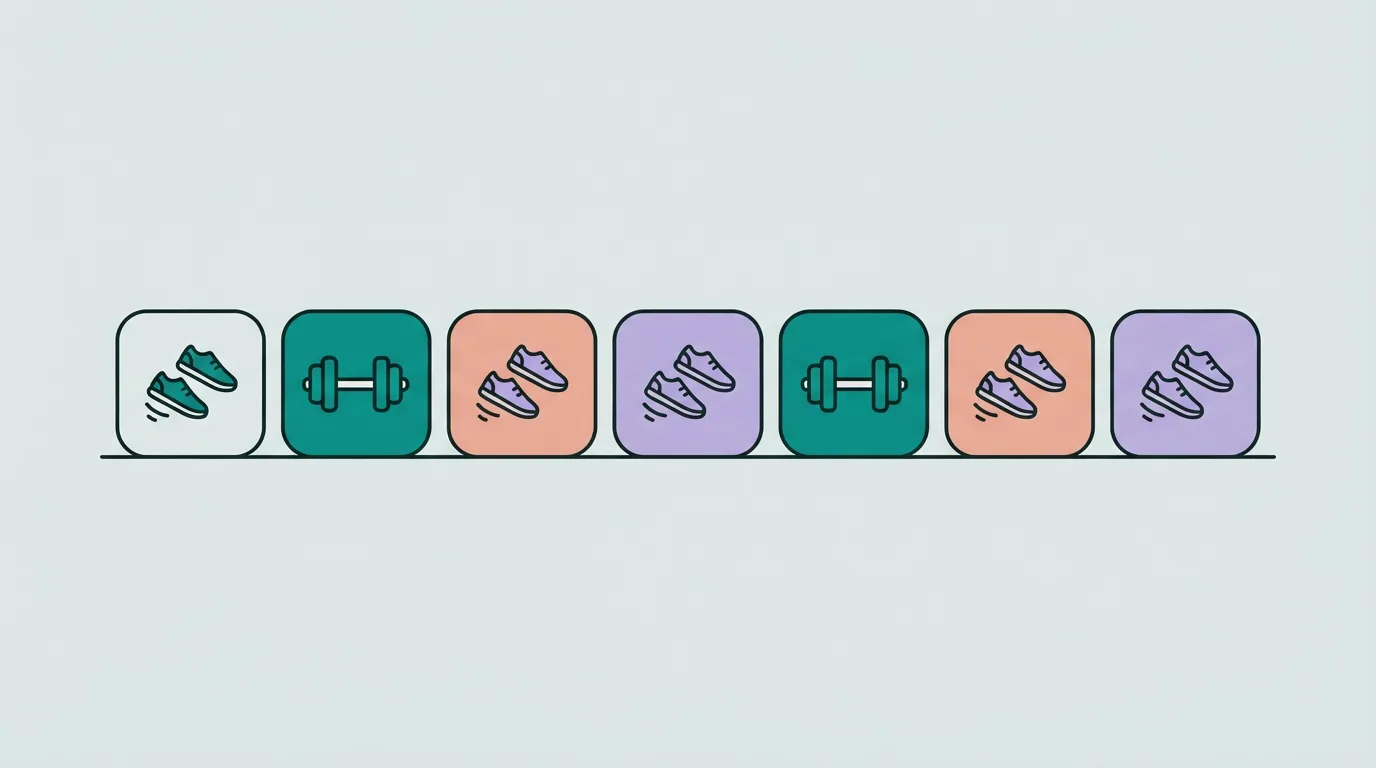
Here is one way to fit the two targets into an ordinary week. It is a pattern drawn from the guidelines, so move the days to suit yours:
- Monday: a 30-minute brisk walk.
- Tuesday: a strength session of 20 to 30 minutes, with a short walk if you like.
- Wednesday: a 30-minute brisk walk.
- Thursday: a 30-minute brisk walk, or a rest day.
- Friday: the second strength session.
- Saturday: a longer walk at an easier pace, with some hills if you have them.
- Sunday: rest, or an easy stroll.
That gives 120 to 150 brisk minutes before you count the weekend walk, and two strength days with rest between them. The home workout for women over 50 fills the strength slots without a gym. Our weekly exercise checker adds up your own week against the guidelines.
Starting from very little walking
If you are not very active now, the NHS advice is to increase your walking distance gradually. Begin with ten brisk minutes a day, which already counts, and add five minutes a week until you reach 30. Raise your daily steps by a thousand or so at a time, holding each level for a week before the next step up.
Comfortable, supportive shoes that do not rub are all the NHS says you need to start. Sore knees are common at this age, and our page on knee arthritis exercises covers strengthening that can make walking easier. If you have a heart condition, have had chest pain or dizziness on exertion, or have not been active for years, read our pre-exercise health check first and talk to your GP where it says to.
My take
I'd start by making walking the daily habit and strength the twice-weekly appointment. My target would be 7,000 to 8,000 steps on most days, with at least 20 minutes of that at a pace where singing would be hard, and I'd count steps for 15 seconds now and then to keep myself honest. I'd protect the two strength sessions above any extra walk, because no amount of walking replaces them for muscle and bone. If weight is the goal, I'd judge it by the weekly average and the waist measurement after three months, and ignore Monday's scale.