Strength training
Resistance band exercises for women over 50
Seven band exercises, done twice a week for 8 to 12 repetitions each, work every muscle group the NHS and the US National Institute on Aging ask you to train. A set of bands fits in a drawer and gives you a pulling move for the back that bodyweight work at home struggles to provide.
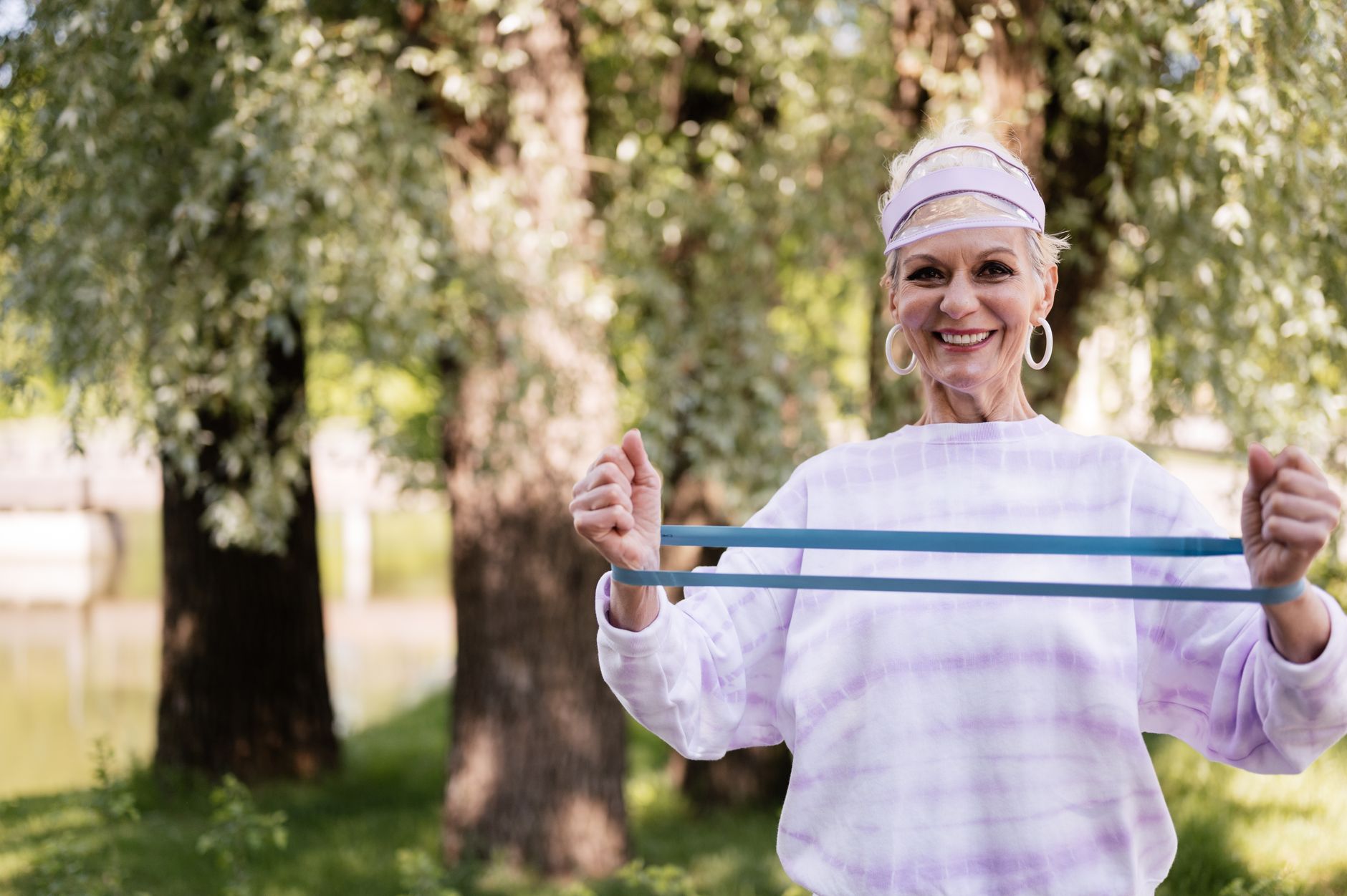
Resistance bands are on the official list. The US National Institute on Aging names them alongside weight machines and hand-held weights as muscle-strengthening equipment, and describes them as "stretchy elastic bands that come in varying strengths" (NIA, Three types of exercise). The NHS lists working with resistance bands among the activities that count towards its two strength days a week (NHS physical activity guidelines for adults).
Do resistance bands build real strength after 50?
They do, according to the best summary of the trials so far. A systematic review pooled 11 controlled studies with 834 people aged 60 to 79 who trained with progressive elastic resistance, and found strong effects on muscle strength in healthy older adults and in those with some functional limitation (Martins and colleagues, Archives of Gerontology and Geriatrics, 2013). The authors also note that the studies said little about how hard people trained, so the review tells you bands work without telling you the ideal dose.
That matters in the years around menopause because muscle is what slips. Our article on whether menopause causes weight gain sets out how lean mass falls across the transition while fat rises, and resistance training is the part of the week that pushes back on the muscle side.
The one real drawback of a band is the way it loads a muscle. Tension builds as the band stretches, so the start of each movement is light and the end is hardest. Dumbbells give you the same weight all the way through, and they are easier to measure: "6 kg" means the same next month, while a band's pull depends on how far you stretch it. I would treat bands as the middle step between bodyweight work at home and dumbbells, and as the travel kit once you have moved on.
Which band to buy
Three kinds cover almost everything a beginner needs:
- A long flat band, the kind physiotherapists hand out, about the length of your arm span or more. It wraps round your feet for rows and round your back for presses.
- A tube band with handles does the same jobs with a better grip, which helps if your hands or wrists ache when you hold a flat band.
- A small loop band goes round your legs above the knees for side steps and bridges, the hip moves a long band handles badly.
Most are sold in sets of three to five strengths, each a different colour. The colours are not standard between makers, so a green band from one brand can be harder than a red one from another. Buy a set from one maker and start with the lightest band for every move.
A resistance band workout for beginners over 50
The NIA suggests that beginners learn each movement without weights or bands until they are comfortable with it. If you have not trained before, two weeks of the no-equipment home workout covers that, and then the band takes over. Warm up for three or four minutes by marching on the spot, then do one set of each move below in order.
| Move | What it works | Start with |
|---|---|---|
| Band sit-to-stand | Thighs and glutes | 1 set of 8 to 12 |
| Seated row | Upper back and biceps | 1 set of 8 to 12 |
| Chest press | Chest, shoulders, triceps | 1 set of 8 to 12 |
| Pull-apart | Upper back and rear shoulders | 1 set of 8 to 12 |
| Loop side step | Outer hips | 8 to 12 steps each way |
| Loop glute bridge | Glutes and hamstrings | 1 set of 8 to 12 |
| Biceps curl | Front of the arms | 1 set of 8 to 12 |
The seven moves
- Band sit-to-stand. Sit on the front of a stable chair with the long band under both feet, holding the ends at your shoulders. Stand up using your legs, then lower yourself back down slowly. This is the NHS sit-to-stand with extra load at the top, where your legs are strongest.
- Seated row. Sit on the floor or a chair with your legs out in front, the band looped round the soles of your feet. Pull both ends towards your lower ribs with your elbows close to your sides, squeeze your shoulder blades together for a second, and let the band back out slowly. This is the move that bodyweight sessions at home tend to miss.
- Chest press. Pass the band behind your back at shoulder-blade height, an end in each hand by your chest. Push both hands straight forward until your arms are long but not locked, then bring them back. A wall press-up works the same muscles, and the band lets you add load without changing the angle.
- Pull-apart. Hold the band in front of your chest with straight arms, hands about shoulder-width apart, and pull your hands out to the sides until the band touches your chest. It is short and light, and it trains the muscles that hold your shoulders back.
- Loop side step. With the small loop above your knees, bend your knees slightly and step sideways, keeping the band taut and your toes pointing forward. The NHS balance routine includes sideways walking, and the loop turns it into hip strength work too.
- Loop glute bridge. Lie on your back, knees bent, feet flat and hip-width apart, the loop above your knees. Press your knees out against the band, lift your hips until your body is straight from shoulders to knees, pause, and lower.
- Biceps curl. Stand on the middle of the long band with your feet hip-width apart, gripping the ends with your palms facing forward. Bend your elbows to bring your hands to your shoulders and lower slowly.
Breathe out as you pull or push and in as you return. The NIA asks you never to hold your breath during strength exercises and to avoid locking your arm and leg joints straight, which matters with a band because a locked elbow lets the joint take the pull instead of the muscle.
How many sets and reps
The NIA says one set of 8 to 12 repetitions of each exercise is effective, and two or three sets may work better. Each set should end at the point where another repetition would be difficult. The NHS says the same thing in plainer words: keep going until you need a short rest before you can carry on (NHS strength exercises).
Twice a week is the minimum both bodies give, and the NIA adds that you should not work the same muscles on two days in a row. Every move above is full-body, so a Monday and Thursday pattern is simple to keep. Our guide to sets, reps and progressive overload over 40 explains how to judge "difficult" honestly, which most beginners underestimate.
Making it harder, and when to move up a band
The NIA describes progress as gradually increasing the weight, the sets or repetitions, or the number of days you train. With a band you have a few extra ways to raise the load before you reach for a stronger one:
- Shorten the band by wrapping it once round your hands or feet, so it starts more stretched.
- Slow the return to three or four seconds, which keeps the muscle working against the band all the way back.
- Add a second, then a third set of the moves that feel easiest.
- Hold two bands together, which is how you fill the gap between two strengths in a set.
I would move up a band for a single exercise once you can do 12 good repetitions for two or three sets and still feel you have a couple more in you. Expect your legs and back to move up long before your shoulders and arms do. When the strongest band in the set is no longer hard for the sit-to-stand and the row, that is the sign to add dumbbells. Our guide on how to start strength training during menopause sets out six beginner dumbbell exercises.
Resistance band exercises for menopause: bones and safety
For bone, the US National Institute of Arthritis and Musculoskeletal and Skin Diseases recommends a mix of weight-bearing exercise, resistance training and balance work (NIAMS, Exercise for your bone health). The standing band moves here, the sit-to-stand and side steps in particular, cover two of those at once. If you have been told you have osteoporosis or low bone density, read our guide to exercise with osteoporosis before you start, since some movements need adapting, and ask your GP or a physiotherapist which suit you.
Look over a band before each session and retire it if you see a nick, a tear or a sticky patch, because that is where latex splits under tension. Hold the ends securely and keep the stretched band away from your face. If a joint hurts during a move, as opposed to the muscle feeling tired, stop that move and ask a GP or physiotherapist about it.
My take
If you have a chair and nothing else, I would buy one set of long flat bands and one set of small loops before dumbbells. The seated row alone is worth it, because it gives the upper back the work that most home routines leave out. Learn the seven moves at the lightest strength, keep two sessions a week on the calendar, and write down which band you used for each move. Our strength week planner helps you place those two sessions around poor nights and symptom days, and the 4-week strength plan gives you the first month week by week.
Comments
No comments yet. Questions and your own experience are welcome.
Thank you. Your comment will appear once it has been reviewed.