Muscle, bone and balance
Sarcopenia in women: when muscle loss starts
Sarcopenia is the loss of muscle strength and muscle mass that builds up over a lifetime, and in women the slide tends to speed up in the late stage of perimenopause. Regular resistance training is the one thing trials consistently show adds muscle back at any age, and protein makes a smaller difference on top of it.
Several of our guides mention sarcopenia in passing. This one explains it: what the word means to a doctor, the tests behind a diagnosis, when the loss starts for women, and what the research says about slowing it down or winning some of it back.
What sarcopenia means
The definition most clinics and researchers use comes from the European Working Group on Sarcopenia in Older People, which revised it in 2018. The group describes sarcopenia as "a progressive and generalised skeletal muscle disorder" that makes falls, fractures, physical disability and death more likely (Cruz-Jentoft and colleagues, Age and Ageing, 2019).
The revision changed what comes first. Older definitions leaned on how much muscle you have. The 2018 version, known as EWGSOP2, puts low muscle strength at the front, because strength predicts bad outcomes better than mass does, and mass is hard to measure accurately outside a research setting. It works in three steps:
- Probable sarcopenia means low muscle strength.
- Confirmed sarcopenia adds low muscle quantity or quality, usually measured with a DXA body scan.
- Severe sarcopenia adds poor physical performance, such as a slow walking speed.
The same paper notes that sarcopenia is now recognised as beginning earlier in life than once thought, and that it has causes beyond age alone.
The tests: grip strength and the chair stand
Each step has a cut-off. For women, EWGSOP2 uses these thresholds (summary table, Annals of the American Thoracic Society, 2021, and the Tromsø study, BMC Geriatrics, 2020):
| What is measured | Test | Low for a woman |
|---|---|---|
| Upper-body strength | Grip on a hand dynamometer | Under 16 kg |
| Leg strength | Five chair rises, arms crossed | Over 15 seconds |
| Muscle quantity | Arm and leg lean mass from a DXA scan, divided by height squared | Under 5.5 kg/m² |
| Physical performance | Usual walking speed | 0.8 m per second or slower |
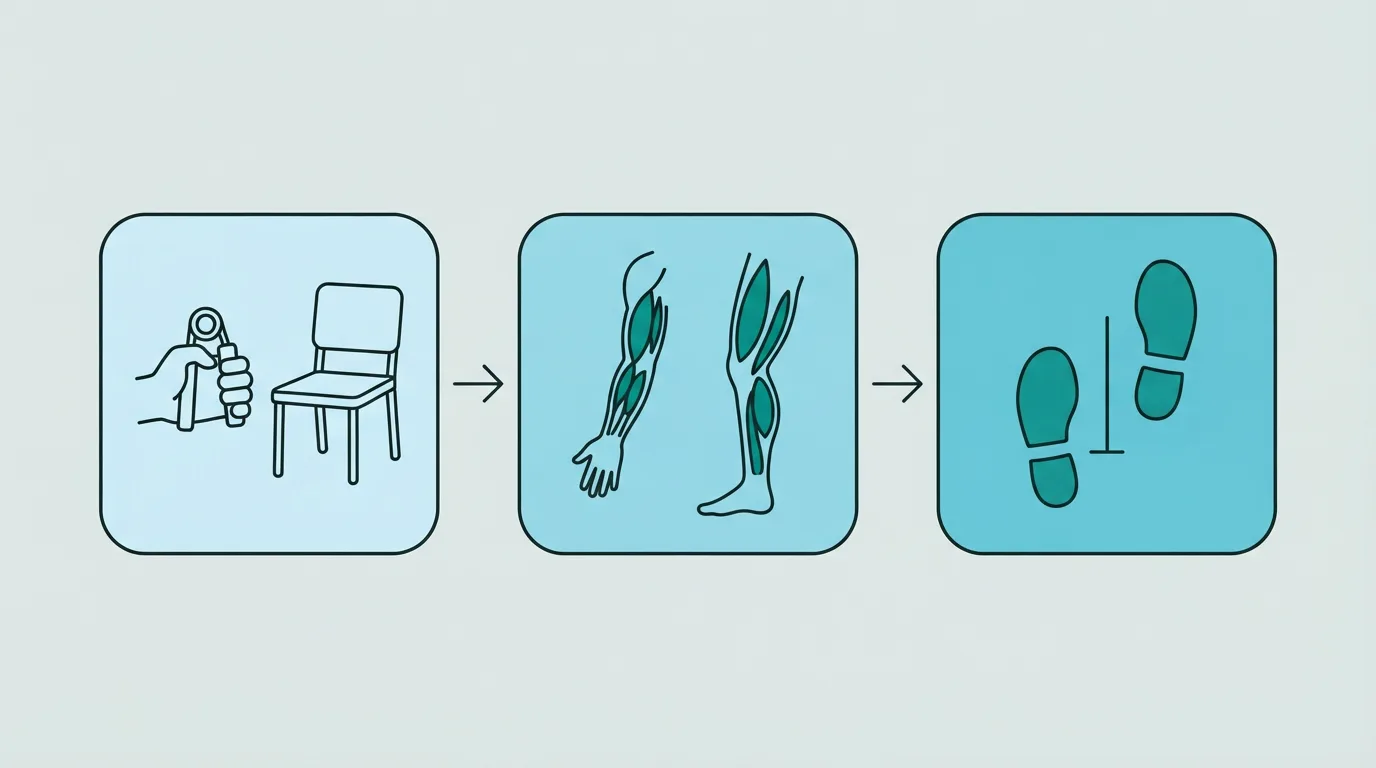
The chair stand is the one most women can picture. In the Tromsø study, people sat on a chair with their arms crossed over their chest and stood up fully five times as fast as they could, timed from sitting to the last stand. The researchers found that the two strength tests pick out different people. Grip flagged smaller, lighter women, while the chair stand flagged heavier women with more body fat. Using the chair stand more than doubled the number of people classed as having probable sarcopenia.
I would read that as a reason to care about leg strength in particular. A slow chair-stand time on its own is a prompt to talk to your GP, since only a clinician can put the pieces together into a diagnosis. To keep an eye on your own legs between appointments, the 30-second chair stand test counts stands instead of timing five, and compares your count with norms for women of your age. If you can get hold of a hand dynamometer, the grip strength test places your reading among British women your age and against the 16 kg line.
When does sarcopenia start in women?
Muscle does not fall off a cliff at 65. The best long-term data for women in midlife come from the US SWAN study, which scanned 1,246 women for years either side of their final period. Before the transition, lean mass crept up slightly. From about two years before the final period to two years after, it started falling while fat gain doubled, and both rates flattened again later (Greendale and colleagues, JCI Insight, 2019). Our article on whether menopause causes weight gain goes through those numbers.
A smaller study points to the same window. Researchers in Colorado scanned 144 healthy women aged 30 to 70 at five stages of menopause. Leg and arm lean mass, adjusted for height, was about 10% lower in late perimenopause than in early perimenopause, and the share meeting a sarcopenia definition jumped from 3% in early perimenopause to 30% in late perimenopause (Ko and Park, Iranian Journal of Public Health, 2021). It was a one-off snapshot of different women, so it shows a pattern across stages rather than the same women changing over time.
Full sarcopenia stays uncommon in midlife. In Tromsø, probable or confirmed sarcopenia by the chair-stand test affected 1.6% of people aged 40 to 59, 4.5% at 65 to 69 and 20.4% at 80 and over. The trend starts in the years around menopause, so muscle built then has the most years left to pay off.
Sarcopenia after menopause: why the transition matters
Ko and Park describe the menopause transition as a vulnerable period for muscle, with falling estradiol the leading suspect. Their own small studies in early postmenopausal women link estradiol to markers of muscle protein breakdown, though they call for more research before anyone can say how much of the loss is hormonal and how much is age. The US National Institute on Aging puts the practical result plainly: during menopause "you could lose muscle and gain fat" (NIA, What is menopause?).
Muscle also protects bone. The US National Institute of Arthritis and Musculoskeletal and Skin Diseases notes that older adults lose muscle and that strong muscles keep us balanced, which matters because falls are what break bones thinned by osteoporosis (NIAMS, Exercise for your bone health). Our guide to balance exercises to prevent falls covers the other half of that protection. If you already have a low bone density result, our guide to exercise with osteoporosis covers which moves to adapt. And if a break has interrupted your training, how fast muscle fades when you stop lifting covers what the detraining studies in people over 60 found.
Reversing sarcopenia in women: what the trials show
The EWGSOP2 authors write that clinicians now have more and more ways of "preventing, delaying, treating, and sometimes even reversing sarcopenia" when it is caught early. Two large reviews show where the gains come from.
Resistance training. A meta-analysis of 49 studies with 1,328 men and women aged 50 and over found that resistance exercise added an average of 1.1 kg of lean body mass. Programmes with more total work produced bigger gains, and older participants gained a little less, which led the authors to suggest that starting earlier in life works better (Peterson and colleagues, Medicine and Science in Sports and Exercise, 2011).
Protein on top of training. A second meta-analysis pooled 49 randomised trials with 1,863 adults who lifted for at least six weeks. Adding protein raised fat-free mass by a further 0.3 kg on average and added a little strength. The extra benefit shrank with age, and beyond a total intake of about 1.6 g of protein per kg of body weight a day, more protein added no more muscle (Morton and colleagues, British Journal of Sports Medicine, 2018).
Set side by side, the training does most of the work and protein adds to it. Food is the simplest way to reach a sensible amount: our guide to protein after menopause sets out how much the guidelines suggest, and the daily protein calculator turns that into grams per meal for your weight. Ask your GP or a dietitian first if you have kidney disease.
What I would do in your forties and fifties
I would start resistance training before any test gives you a reason to. The NHS recommends that adults do muscle-strengthening activities on at least two days a week, covering the legs, hips, back, abdomen, chest, shoulders and arms, and working hard enough to need a short rest before carrying on (NHS physical activity guidelines). Its home routine opens with the sit-to-stand, the same movement the chair-stand test measures, so the first exercise you learn trains the first thing a clinician would check.
- Learn the basics with our guide on how to start strength training during menopause, or follow the 4-week plan if you prefer each session written out.
- Give the legs priority. Sit-to-stands, squats to a chair and step-ups cover the muscles behind both the chair test and walking speed.
- Add load over time. The Peterson review found more total work meant more muscle, and our guide to sets, reps and progressive overload explains when to add weight.
- Spread protein across your meals instead of saving it for dinner, using the calculator above as a guide.
See your GP if you find it hard to get out of a chair without using your arms, if your grip has weakened enough to make jars or bags difficult, or if you have had a fall. They can arrange the strength tests and, where needed, a scan.
Comments
No comments yet. Questions and your own experience are welcome.
Thank you. Your comment will appear once it has been reviewed.