Strength training
Gym workout for women over 50
A first gym session for a woman over 50 can be six machines, one set of 10 to 15 slow repetitions on each, at a weight light enough that the last two feel hard but your form holds. Do it twice a week, ask for an induction before the first visit, and add a second set and a little weight over the following weeks.
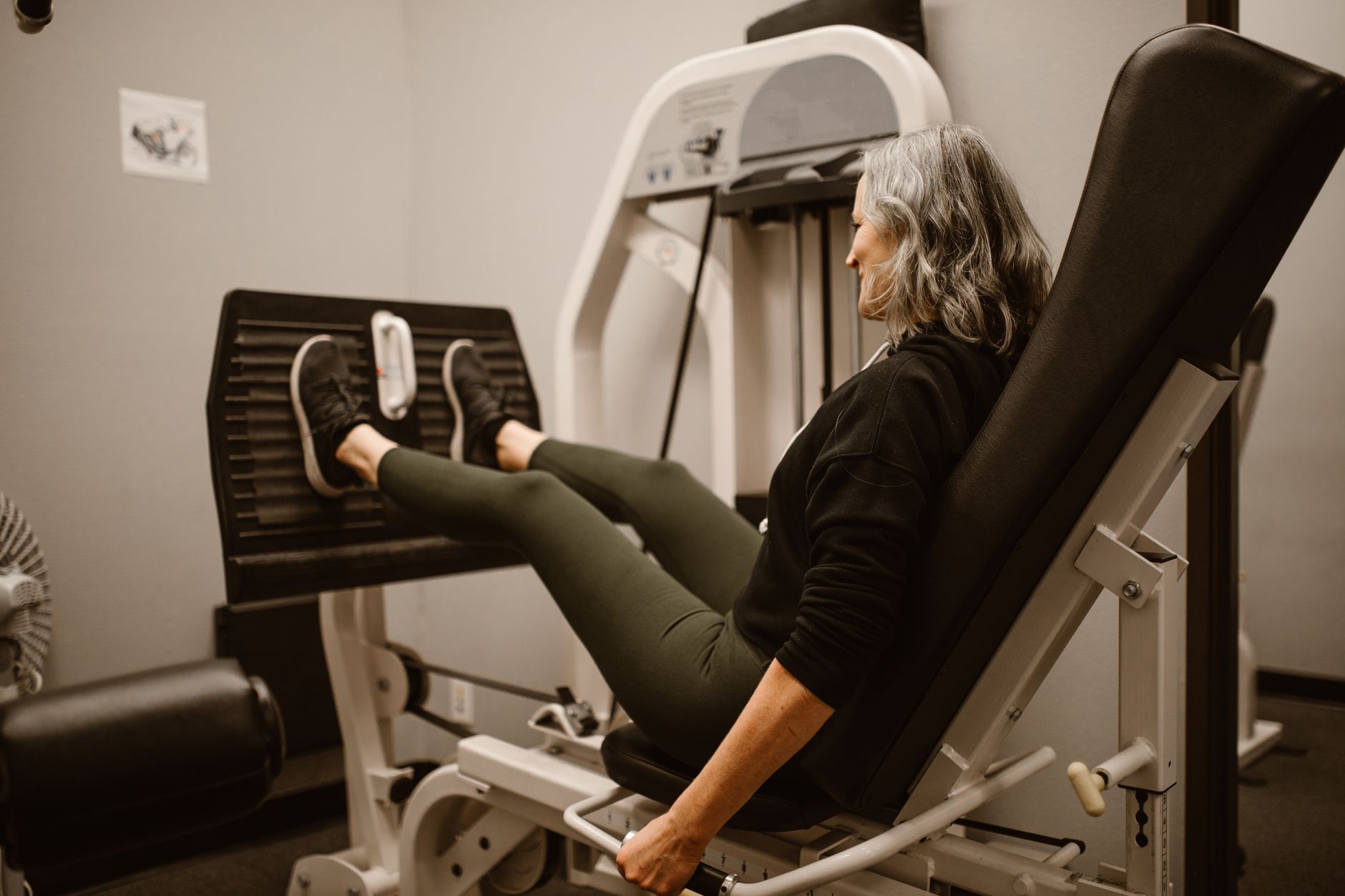
The NHS asks adults to work every major muscle group, legs, hips, back, abdomen, chest, shoulders and arms, on at least two days a week (NHS physical activity guidelines for older adults). Weight machines are one of the simplest ways to do that if you are new to lifting. The National Strength and Conditioning Association, a US body for strength coaches, says machines are an appropriate place to start for beginners and for anyone with limited mobility, and that people who already lift with confidence get more out of free weights (Fragala and colleagues, NSCA position statement, 2019). The session below is built from the exercise list in that statement.
Gym or home for strength training
Both work. Muscles grow when you make them work hard, and a chair, a wall and a set of bands give them enough to do for the first few months. Our home workout for women over 50 covers the NHS routines with no equipment at all.
The gym has three things home cannot match. It has weights that go up in small steps for years, so you never run out of load. It has machines that support your back and set the path of each lift. And it usually has staff who can show you how to use them. That last point matters more than it sounds. A 2017 review of 11 trials in healthy adults over 65 found that supervised strength and balance training improved strength more than the same kind of programme done alone at home, and its authors suggested making two of every three weekly sessions supervised (Lacroix and colleagues, Sports Medicine, 2017). Most of the studies were small, and the gap was smaller when the home group had a few coached sessions too.
Home wins on cost, time and privacy, and on the days you would never make the trip. My take: if a gym or leisure centre is near enough to reach without dreading it, join and use the instructors while you learn. If it is not, train at home and book even two or three sessions with an instructor or a class to check your form, because that alone narrowed the gap in the review. A mix works too: one gym day and one home day a week still meets the NHS minimum.
Which machines match the NHS moves
If you have done the NHS home routines, most machines are a loaded version of a move you already know. The NSCA list includes the leg press, leg curl, chest press, lat pull-down, shoulder press, biceps curl, triceps extension, back extension and heel raise. For a first session I would choose these six:
- Leg press for the sit-to-stand and mini-squat. You sit with your back against a pad and push a footplate away, so the thighs and bottom work while the seat holds your balance.
- Seated leg curl for the back of the thigh, the muscle the NHS standing leg extension targets.
- Chest press for the wall press-up. You push two handles forward from chest height.
- Seated row for the upper back, the band row from our resistance band exercises. You pull handles towards your ribs and squeeze the shoulder blades together.
- Lat pull-down for the back and arms. You pull a bar down to your upper chest. Home routines have no real match for it.
- Calf raise on the leg press, pushing through the balls of your feet with your knees almost straight, for the NHS calf raise.
That covers legs, hips, chest, back, shoulders and arms. The abdomen gets the balance moves at the end, and the shoulder press can wait until the six above feel familiar, because the NSCA asks for particular care with the shoulder joint.
A first session on the machines
Allow 35 to 45 minutes. Move from one machine to the next in this order, which puts the big leg muscles first while you are fresh and alternates pushing with pulling.
- Warm up for five minutes on an exercise bike or a treadmill at a pace where you can still talk.
- Leg press, 10 to 15 repetitions.
- Chest press, 10 to 15.
- Seated row, 10 to 15.
- Seated leg curl, 10 to 15.
- Lat pull-down, 10 to 15.
- Calf raise on the leg press, 10 to 15.
- Balance to finish: a heel-to-toe walk along a wall and a one-leg stand with a hand on a rail, from our balance exercises.
One set of each is enough on day one. The NSCA statement says beginners gain about as much from one set as from several, and suggests 10 to 15 repetitions for anyone starting out. Rest for a minute or two between machines. The statement uses up to two minutes between sets, and there is no prize for hurrying.
Setting up each machine
- Adjust the seat before you load it. Many machines carry a diagram showing which joint should line up with the pivot: your knee for the leg curl, the handles at mid-chest for the chest press.
- Set the pin in the weight stack at the lightest plate or the one above it for your first set.
- Push or pull in about two seconds and lower in two or three, so the plates never crash down.
- Breathe out as you push or pull and breathe in as you return, so you never hold your breath through a lift.
- Stop short of locking your knees on the leg press or your elbows on the chest press.
- Write down the seat setting and the weight for each machine. Next time you can set up in seconds.
How heavy the weight should be
The right weight is the one where the last two repetitions are hard work and your form still looks the same as on the first. The NHS describes the goal as working each muscle until you need a short rest before you could do another set. If you reach 15 and could carry on, the weight is too light. If your back lifts off the pad or you jerk the handle to finish, it is too heavy.
You do not need to go until you cannot move the weight at all. The NSCA review found no extra benefit at this age from training to failure, and says that moderate loads with good form are a safe and sufficient stimulus for many people. Our page on sets, reps and progressive overload over 40 explains how to judge effort and when to move up.
A gym workout plan for women over 50: the first four weeks
Train on two days that are not back to back, such as Monday and Thursday. The NSCA statement recommends two to three days a week for older adults, so a third day can come once two feel routine.
- Weeks 1 and 2: one set of 10 to 15 on each of the six machines. Spend the time learning the settings.
- Weeks 3 and 4: two sets on each machine, with a rest between them.
- Whenever 15 repetitions feel easy on both sets: move the pin down one plate on that machine and drop back to 10.
By the end of the month most women can work towards the NSCA's two to three sets per muscle group. Our 4-week strength training plan lays out a first month with home equipment and fits on a single printed page. You can follow its rhythm with the machines in place of the chair moves. On the days in between, walking counts towards the NHS 150 minutes of moderate activity a week.
Your first visit
Ask whether the gym runs an induction or a free first session with an instructor before you sign up. It is the supervision the 2017 review found useful, and it is the moment to have each seat set for you. Tell the instructor about anything that affects how you move, such as a sore knee, a recent fall or a low bone density result. Ask the staff when the gym is quietest and book your first few sessions then, so you can take your time at each machine.
Wear trainers with a flat sole and clothes you can bend in, and bring water. If you leak a little when you push hard, the pelvic floor exercises and lifting tips on this site help, and an instructor can lower the load while you work on it.
Before you start
The NHS asks anyone who has not exercised for some time, or has a medical condition, to speak to a GP first. Our pre-exercise health check takes you through the questions in a couple of minutes. The NSCA statement adds that resistance training is generally safe with controlled high blood pressure and should wait while it is uncontrolled, and that anyone with an unstable condition should see a doctor first. If you have osteoporosis, read exercise for women with osteoporosis before you load the leg press or the row.
Some stiffness in the muscles a day or two after the first sessions is normal. Sharp pain in a joint during a lift is a reason to stop that machine and ask a GP or physiotherapist about it. For the reasons strength work matters in these years, start with strength training during menopause: how to start.