Strength training
Low-impact cardio after 50 and your heart-rate range
Type your age to see the pulse that matches moderate and vigorous effort, then pick the cardio that suits your knees and your bones and fit it around two strength days.
Moderate cardio sits at about 50 to 70 percent of your maximum heart rate, and vigorous at about 70 to 85 percent, with the maximum estimated as 220 minus your age (American Heart Association). At 55 that puts moderate effort at roughly 83 to 116 beats a minute. Walking, cycling, swimming, rowing and the elliptical can all reach that range without jumping, and the NHS asks for 150 minutes of it a week on top of two strength days.
Work out your heart-rate range
Example: age 55, resting pulse 70
83 to 116 bpm
That is the moderate range from an estimated maximum of 165. Counting from a resting pulse of 70, the heart-rate reserve method puts moderate effort a little higher, at 108 to 126.
| Method | Moderate | Vigorous |
|---|---|---|
| Percent of maximum | 83 to 116 | 116 to 140 |
| Heart-rate reserve | 108 to 126 | 127 to 155 |
An estimate in beats a minute from population formulas, which can miss one person's true maximum by more than ten beats. Medicines that slow the heart lower every number here. It is not a medical test, and nothing you type leaves this page.
How the range is worked out
The calculator first estimates your maximum heart rate. By default it uses 220 minus your age, the rule behind the American Heart Association chart. The second option is the formula Martha Gulati's team published in Circulation in 2010 from 5,437 healthy women aged 35 and over: 206 minus 0.88 times your age. It gives women a lower maximum, 162 instead of 170 at age 50 (Northwestern Medicine on the Gulati study). Choose it and every range comes out a few beats lower.
The first row of the result multiplies that maximum by the American Heart Association's bands: 50 to 70 percent for moderate and 70 to 85 percent for vigorous. The second row only appears when you enter a resting pulse. It uses the Karvonen method, also called heart-rate reserve: take the maximum, subtract your resting pulse, multiply the difference by the percentage, then add the resting pulse back. The American College of Sports Medicine sets moderate at 40 to 59 percent of that reserve and vigorous at 60 to 89 percent (Evenson and Hesketh, American Journal of Lifestyle Medicine, 2021). Because it starts from your own resting pulse, a fit woman with a low resting rate gets a range that sits closer to what her heart actually does.
Treat both rows as a target zone with soft edges. The same review shows the age formulas carrying a likely error of 11 to 12 beats either way for any one person.
A worked example
Take a woman of 55 whose resting pulse is 70. Her estimated maximum is 220 minus 55, which is 165. Half of that is 82.5 and 70 percent is 115.5, so her moderate range rounds to 83 to 116. Vigorous runs from 116 to 140, matching the 50 to 85 percent span of 83 to 140 printed in the AHA chart for age 55.
With the reserve method she subtracts 70 from 165 and gets 95. Forty percent of 95 is 38, plus 70 makes 108. Fifty-nine percent is 56, plus 70 makes 126. Her moderate range moves up to 108 to 126, and vigorous becomes 127 to 155. If she chooses Gulati's formula instead, her maximum drops to about 158 and each figure shifts down by five to seven beats.
The talk test, and when to trust it over the numbers
The NHS describes moderate activity as effort that raises your heart rate and makes you breathe faster and feel warmer, where you can still talk but cannot sing. At vigorous effort you cannot say more than a few words before you need a breath (NHS physical activity guidelines). You need no watch for it, and it adjusts by itself on a hot day, on a hill, or in a week of poor sleep.
Lean on the talk test when your pulse and your breathing disagree. The heart association warns that some medicines lower your maximum and your target zone, and asks anyone with a heart condition or on medication to get their own target from a health professional. A hot flush mid-session can also push your pulse up for a minute without the work getting any harder. Our page on hot flashes during exercise covers what helps in the moment.
To check by hand, put the tips of two fingers on the thumb side of your inner wrist, count for 30 seconds and double it. Take your resting pulse in the morning before you get out of bed, which is when the AHA suggests counting it. Between 60 and 100 is the normal adult range.
Walking, cycling, swimming, rowing or the elliptical
All five reach moderate effort with little jarring, which is why they are called low impact. They differ in how much load they put through your bones, and that matters after menopause. The Royal Osteoporosis Society describes impact exercise as the force that travels through your bones each time your feet hit the ground, and lists walking and stair climbing as examples (Royal Osteoporosis Society). It says bone does best with both impact and strength work.
| Activity | Joints | Bone loading |
|---|---|---|
| Brisk walking | Gentle landings on every step | Light impact through legs and hips |
| Cycling | Seated, knees bend without landing | Little: no foot strike |
| Swimming, aqua aerobics | Water carries your weight | Little: evidence for bone is thin |
| Rowing machine | Seated, no landing | Muscle pull on legs, back and arms |
| Elliptical | Standing, feet stay on the pedals | You carry your weight, with no landing |
Brisk walking
The NHS puts a brisk walk at about 3 miles an hour, fast enough that singing would be hard (NHS walking for health). It is the only one of the five that the Royal Osteoporosis Society names as impact exercise, and it costs nothing but shoes. Our guide to walking for weight loss after 50 covers pace, steps a day and how cadence lines up with moderate effort.
Cycling, outdoors or static
On a bike the saddle takes your weight, so your knees bend and straighten without any landing at all. An NHS osteoarthritis care plan lists cycling among the low-impact options and suggests starting in the lowest gear or resistance (Sherwood Forest Hospitals NHS osteoarthritis care plan). An analysis of 217 trials ranked walking, cycling and swimming as the aerobic exercise that did most for knee osteoarthritis pain and function (Harvard Health). For bone it does little, because there is no foot strike.
Swimming and water classes
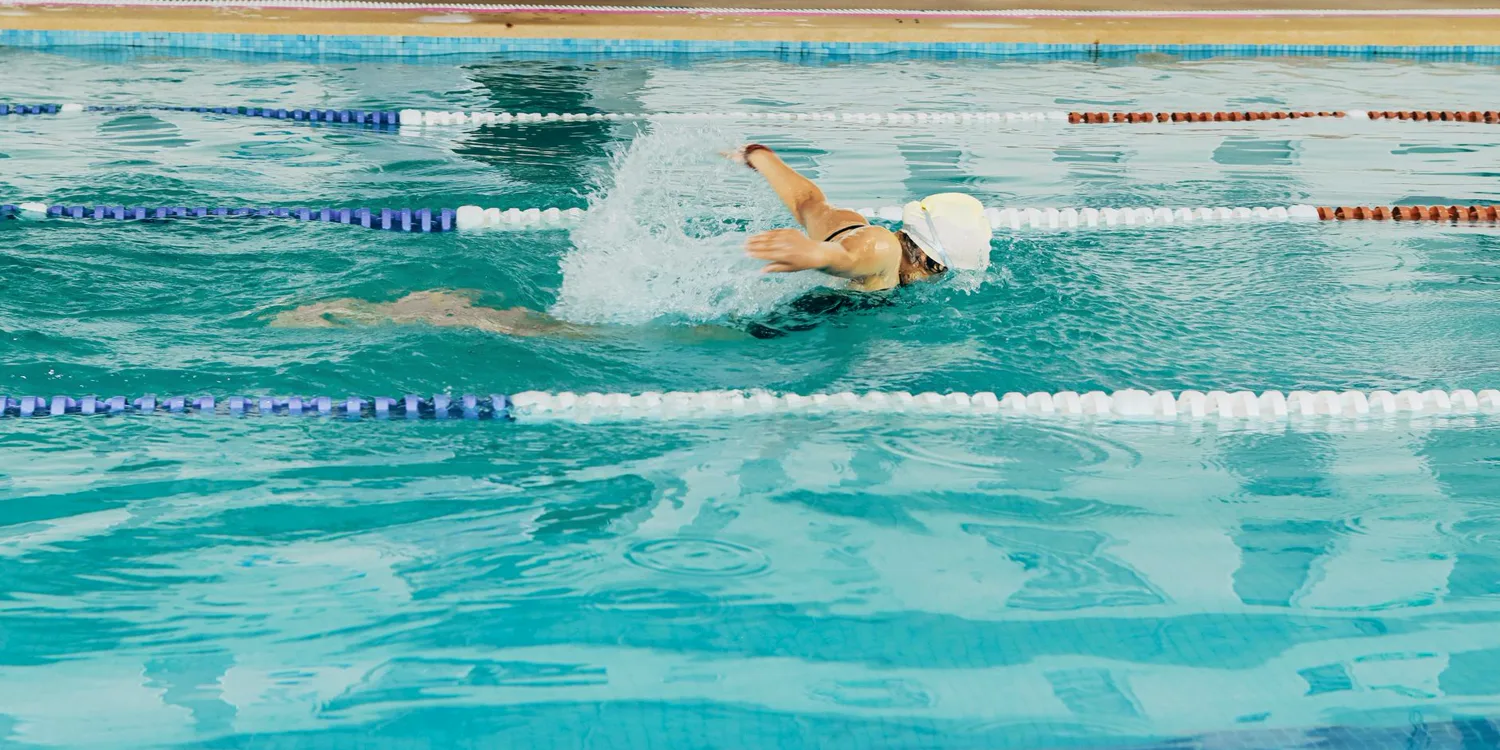
Water holds most of your weight, which makes a pool the easiest place to start when hips or knees ache. For bone, the research is thin. A 2020 meta-analysis found five studies with 263 women, and lumbar spine density was higher only in postmenopausal women who swam 3 to 6 hours a week, with no effect below 3 hours (Su and colleagues, BioMed Research International, 2020). The authors say the question needs more research, so count swimming for your heart and lungs and look elsewhere for bone.
Rowing machine
A rowing stroke drives with the legs, then the back and arms finish the pull, so more muscle shares the work than on a bike. It is seated and has no landing. Because the stroke bends you forward and back, the Royal Osteoporosis Society's advice applies here first: if you have had spinal fractures or are recovering from a broken bone, talk to your doctor or a physiotherapist before you start.
Elliptical trainer
You stand on an elliptical, so your legs carry your body weight, but your feet never leave the pedals and there is no landing to absorb. A sports medicine doctor quoted by the Arthritis Foundation names it with walking and cycling as a sensible low-impact choice for people with osteoarthritis (Arthritis Foundation). It comes into its own on icy mornings and dark evenings, when a walk outside is out of the question.
How much: 150 minutes around two strength days
The NHS asks adults for at least 150 minutes of moderate activity or 75 of vigorous a week, spread over four or five days or every day, and treats a mix of the two as meeting the target. Strength work on at least two days comes on top of that, on the same days or different ones. US guidance gives a range of 150 to 300 minutes and dropped the old rule that only 10-minute bouts counted (US Office of Disease Prevention and Health Promotion).
Here is one way the week can look with two strength sessions already in place:
| Day | Strength | Cardio |
|---|---|---|
| Monday | 30-minute session | 10-minute walk afterwards |
| Tuesday | Rest | 30-minute brisk walk |
| Wednesday | Rest | 30 minutes on the bike or in the pool |
| Thursday | 30-minute session | 10-minute walk to cool down |
| Saturday | Rest | 40-minute walk with hills |
| Sunday | Rest | 30 minutes on the elliptical or rower |
That adds up to 150 minutes, and the hills on Saturday may push part of that walk into vigorous effort, which counts double. Friday stays free. If two strength sessions do not fit your week yet, the strength week planner places them around sleep and symptom days, and the weekly exercise checker adds up what you already do.
What cardio adds that lifting does not
Lifting builds muscle, and cardio does more for fat inside the abdomen. A 2023 meta-analysis of 101 trials in 5,697 postmenopausal women found aerobic and combined training did more for fat mass, and resistance and combined training more for muscle, and the authors called the combination a viable strategy (Khalafi and colleagues, Frontiers in Endocrinology, 2023). Our page on menopause belly fat goes through what those trials measured at the waist.
My take: where I would start
I'd start with brisk walking as the base, because it is the one choice here that also loads bone, and I'd keep the bike, pool, rower or elliptical for the days a knee or the weather says no. I'd skip buying a heart-rate strap until the talk test feels familiar, then judge the strap by whether it agrees with your breathing and with the range above. If your knees are the limit, our knee arthritis exercises pair well with cycling. With a low bone density result, exercise for women with osteoporosis sets out the impact and lifting that work alongside it.
Before you raise the effort
The NHS asks you to speak to a GP first if you have not exercised for some time or have a health condition, and the AHA asks the same of anyone taking medicine that affects heart rate. Our pre-exercise health check lists the questions to answer. Start near the bottom of your moderate range and build the minutes before the pace. More on building a full week is in our strength training guides.