Weight and body changes
Menopause belly fat: why it grows and what helps
During the menopause transition fat starts collecting around the waist and deep inside the abdomen, even when the scale barely moves. Crunches will not shift it, but regular brisk exercise does, and strength work keeps the muscle these years take away.
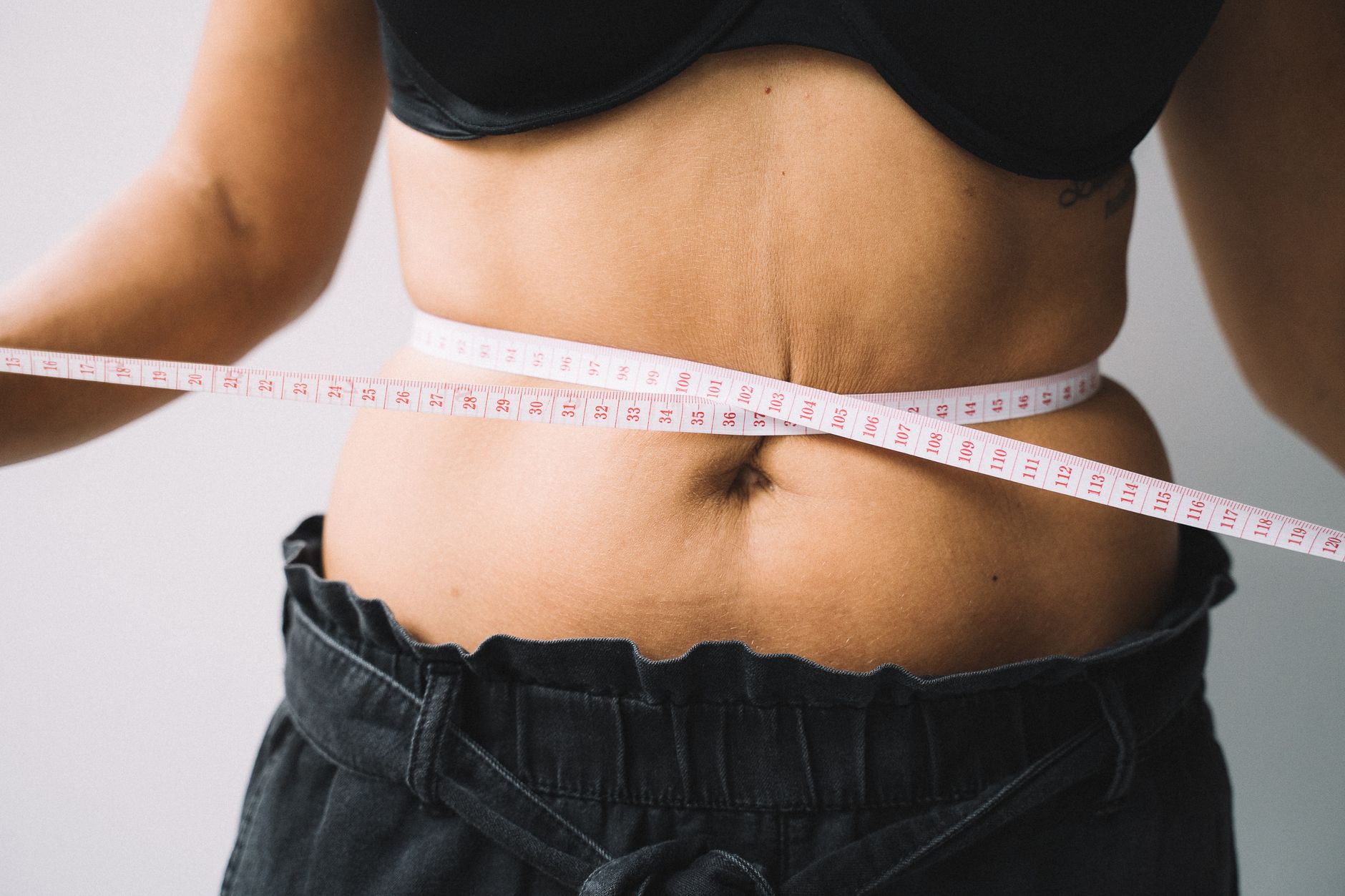
Belly fat and menopause are linked by more than age. A long-running US study that scanned women over many years found that fat around the middle, and especially the fat packed around the organs, begins to grow faster once the transition starts. The way to lose menopause belly fat is the same slow work as losing fat anywhere, with one difference worth knowing: the deep fat answers to moving more, and the muscle you keep decides how your shape holds up afterwards.
Why belly fat appears in menopause
The Study of Women's Health Across the Nation (SWAN), funded by the US National Institutes of Health, followed 380 women for a median of almost 12 years and measured where their fat sat using body scans (Greendale and colleagues, Journal of Clinical Endocrinology and Metabolism, 2021). The women were about 46 at the start. Each woman's scans were lined up against the date of her final period, which separates the effect of menopause from the effect of birthdays.
Fat in the belly area (the scans call it android fat) was already creeping up before the transition, by about 1.2% a year. Once the transition began it rose about 5.5% a year. Fat deep inside the abdomen, called visceral fat, did not grow at all before the transition and then rose by about 6.2% a year. After menopause both slowed, to roughly 1.5% a year for visceral fat and under 1% for the belly as a whole, while fat on the hips and thighs started to shrink a little. The authors conclude that the transition itself is linked to the development of central fat.
The same research group had already shown that the total amount of fat gained roughly doubles at the start of the transition while muscle begins to fall, with no sudden jump on the scale (our article on whether menopause causes weight gain walks through those numbers). Put the two studies together and belly fat from menopause makes sense: more fat overall, and more of it landing in the middle. The National Institute on Aging says the same in plain words, that during the transition fat is stored in different places and your waist could get larger (NIA, What is menopause?).
Two kinds of belly fat
The fat you can pinch sits just under the skin and is called subcutaneous fat. Visceral fat lies deeper, inside the muscle wall of the abdomen and around the organs, where you cannot feel it. A review of exercise trials on visceral fat opens by noting that where extra fat is stored, and visceral fat in particular, matters when judging the health effects of carrying extra weight (Ismail and colleagues, Obesity Reviews, 2012).
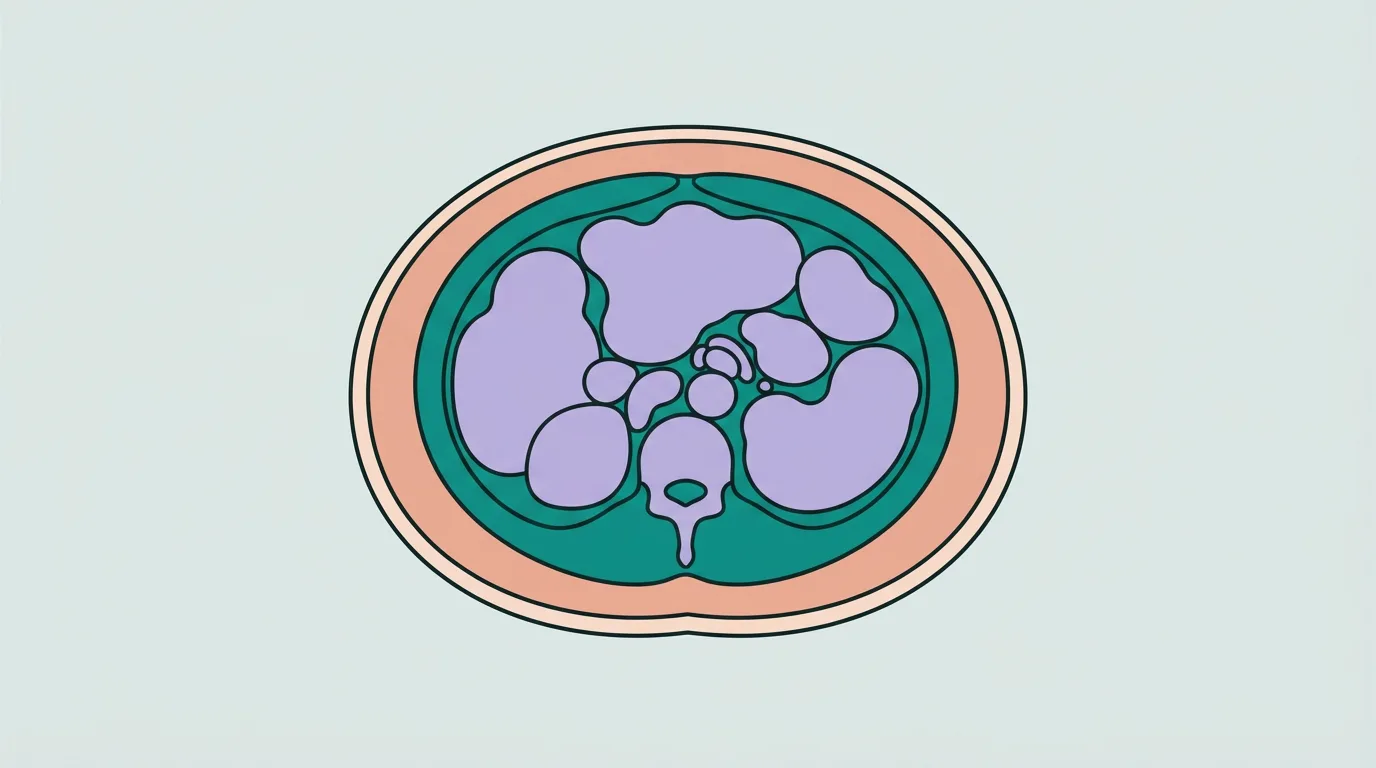
The trials below measured visceral fat with CT or MRI scans, because a mirror cannot show it. At home you have no scanner, so the waist measurement stands in for both layers.
Measure your waist, then watch the trend
NICE, which writes guidance for the NHS in England, uses waist-to-height ratio to spot fat around the middle in adults with a BMI under 35. A ratio of 0.5 or more counts as increased health risk, and 0.6 or more as high risk, so the aim is a waist under half your height (NICE guidance on assessing central fat). To measure, find the bottom of your ribs and the top of your hips, put the tape halfway between them (for most people just above the belly button) and read it after a normal breath out. Our waist-to-height ratio checker does the sum and shows which NICE band you fall in.
Expect the tape to move slowly. In the SWAN scans, waist size grew at much the same pace before, during and after the transition, and the authors note that a tape measure picks up changes in fat distribution less well than a scan does. A single month tells you little. Measure on the first morning of each month, before breakfast, and judge the line over three to six months.
Why sit-ups will not flatten it
Working the stomach muscles does not burn the fat lying over them. In a small randomised trial, sedentary adults did seven abdominal exercises, two sets of ten, five days a week for six weeks, while a control group did nothing new and everyone kept their diet the same (Vispute and colleagues, Journal of Strength and Conditioning Research, 2011). The exercise group finished with no change in body fat, belly fat on the scan, waist size or skinfolds. What they gained was stamina in the muscles themselves: by the end they managed 47 curl-ups on average, against 32 in the control group.
The trial was short and its 24 volunteers were 18 to 40, so it says nothing directly about women in midlife. It does fit the wider evidence that fat loss comes from the whole body. Core work still earns its place for posture, lifting things safely and getting up off the floor. It just will not shrink a waist on its own, and if you have low bone density, check how to adapt sit-ups in our guide to exercise with osteoporosis.
How to lose belly fat in menopause: the trials
The clearest trials of visceral fat measure it with CT or MRI scans, and they point one way. The 2012 review pooled 35 randomised trials in overweight adults. Aerobic exercise, the kind that keeps you breathing harder for a sustained stretch, reduced visceral fat compared with no exercise. Resistance training on its own did not show a significant effect, and the authors suggest that even less aerobic exercise than obesity guidelines ask for may be enough to reduce visceral fat.
Two Canadian trials looked at postmenopausal women specifically. In the first, 320 inactive women aged 50 to 74 were asked to do 45 minutes of moderate to vigorous aerobic exercise five days a week for a year, without changing their diet (Friedenreich and colleagues, International Journal of Obesity, 2011). They managed about 3.6 days and just under three hours a week on average. Compared with the control group they lost about 1.8 kg of body weight and 2 kg of fat, and CT scans showed less fat both in the deep layer and in the pinchable one over the belly.
The more they exercised, the more fat they lost.
The follow-up trial compared 150 with 300 minutes a week in 400 inactive postmenopausal women for a year (Friedenreich and colleagues, JAMA Oncology, 2015). The higher dose took off more total fat and more subcutaneous belly fat. Visceral fat fell by about the same amount in both groups. For the deep fat that SWAN saw rising, two and a half hours of brisk exercise a week did as much as five hours, which matches the 150 minutes the NHS asks of every adult.
Lifting has its own evidence, aimed at the other half of the problem. In a six-year Arizona trial, the postmenopausal women who came to the most strength sessions gained less fat around the trunk than those who came least (Bea and colleagues, Medicine and Science in Sports and Exercise, 2010). A 2023 review of 101 trials in postmenopausal women found that exercise of every kind lowered visceral fat, with aerobic and combined training doing more for fat and resistance training doing more for muscle (Khalafi and colleagues, Frontiers in Endocrinology, 2023).
Exercises for menopause belly fat: a weekly mix
The exercises that help most are the ones that keep you moving at a steady, breathing-harder pace for half an hour or more: brisk walking, cycling, swimming, dancing. (Our guide to walking for weight after 50 covers pace and daily steps.) Those are what shrank visceral fat in the Ismail review and the Friedenreich trials. Add two strength sessions that work the whole body, because the 101-trial review found that combining the two did as much for fat as aerobic work alone and as much for muscle as lifting alone, and its authors call the mix a viable strategy for body composition after menopause.
Here is one way a week can look. It reaches the 150 moderate minutes the NHS guidelines ask for, and it keeps a rest day between the two lifting days, as the US National Institute on Aging advises for the same muscles.
| Day | What to do |
|---|---|
| Monday | Brisk walk, 30 minutes |
| Tuesday | Full-body strength session, about 30 minutes |
| Wednesday | Brisk walk or bike ride, 30 minutes |
| Thursday | Brisk walk, 30 minutes |
| Friday | Full-body strength session, about 30 minutes |
| Saturday | Longer walk, swim or ride, 60 minutes |
| Sunday | Rest, or an easy stroll |
The NHS does not count strength time toward the 150 minutes, so the lifting sits on top of the walking. Each strength session takes a squat or sit-to-stand, a hip hinge such as a Romanian deadlift or glute bridge, a row, a press and a step-up, which between them cover the legs, hips, back, chest and shoulders. Our guide to starting strength training in menopause shows each move with an easier version, the home workout for women over 50 does the same with no equipment, and the 4-week strength plan sets out every session of the first month. For how many repetitions to do and when to go heavier, see sets, reps and progressive overload.
Crunches and planks can go at the end of a strength session if you like them. On their own they fall short for the reason the sit-up trial above showed: they build stamina in the stomach muscles and leave the fat over them where it was. The fat comes off with the whole-body work and the walking.
If you are still in perimenopause, there is no reason to wait for your periods to stop. In SWAN, visceral fat held steady until the transition began and then rose by about 6% a year, years before the final period. A week like this one is worth building while that change is under way. The strength week planner fits the two sessions around bad nights and symptom days.
What I would do first
If your waist has grown in your late forties, I would not try to start the whole week at once. I would begin with the walks, at a pace where you can still talk but not sing, which is how the NHS describes moderate activity. Walking is the dose the trials used to shrink visceral fat, and it fits around work. After two or three weeks I would add the first strength session, then the second, because SWAN shows muscle starts slipping in the same years, and muscle is what keeps you strong, steady on your feet and able to keep up the walking.
Food matters too, though no single food targets the belly. The NHS advice for menopause is a healthy, balanced diet alongside regular exercise (NHS, Things you can do), and the exercise trials above asked women not to change how they ate, so their results came from the exercise alone. Eating enough protein helps you hold on to muscle while fat comes off: see how much protein you need after menopause. For the whole weekly routine, with meals and walking built around the lifting, read how to prevent menopause weight gain.
When to see a GP
The NHS lists a waist measurement over half your height as one reason to see a GP about your weight (NHS, Obesity). Make an appointment as well if your waist grows quickly or alongside other changes you cannot explain, rather than putting it down to menopause. If you have not exercised for a long time or live with a health condition, the NHS suggests talking to a GP before you start a new routine.