Strength training
Health-related fitness check: five tests at home
Each of the five components has one short test, and all you need is a chair, a tape measure and a timer. Enter what you score to see where each one sits for your age.
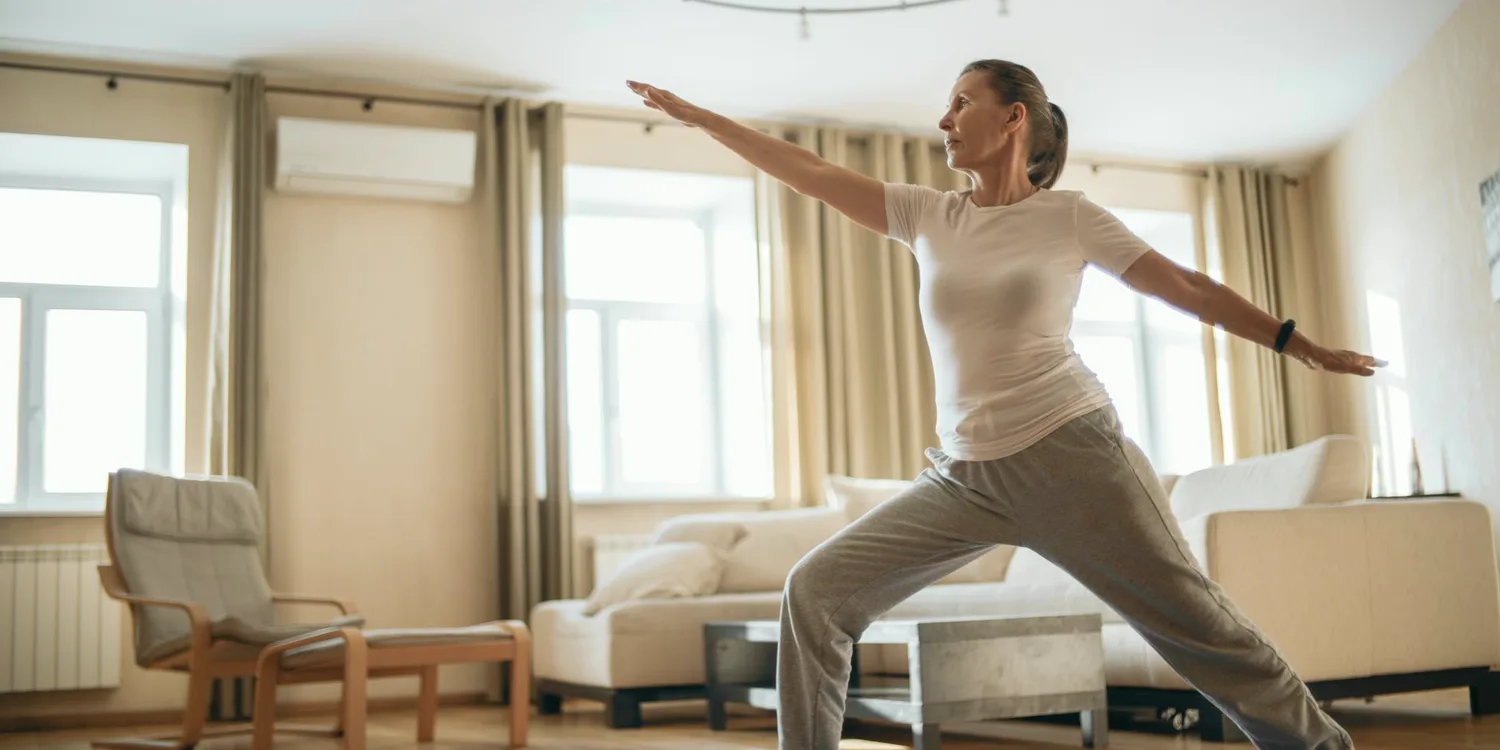
Health-related fitness has five components: cardiorespiratory endurance (how long you can keep up brisk, whole-body movement), muscular strength (the force a muscle produces in one maximum effort), muscular endurance (how long a muscle keeps working before it tires), flexibility (how far your joints move) and body composition (the share of fat against muscle, bone and water). That list comes from the American College of Sports Medicine and is set out in the University of Minnesota's open textbook on physical activity. Each one can be measured at home with a test from the Senior Fitness Test, plus a waist measurement for body composition.
The check below takes those five scores and your age, and places each one against the women's ranges published by Jones and Rikli, the researchers who built the test from 7,183 adults aged 60 to 94. It is a screening estimate, and it tells you which component to work on first. If you want to know what better strength and endurance would change day to day, four ways stronger muscles change everyday life after menopause sets out the evidence for stairs, falls, blood sugar and sleep.
Your five-component check
Example: a 63-year-old woman
Work on leg strength first
- Heart and lungs: 82 knee lifts is inside the range for 60 to 64 (75 to 107).
- Strength: 11 chair stands is one short of the 60 to 64 range (12 to 17).
- Endurance: 16 arm curls sits mid-range for her age band (13 to 19).
- Flexibility: a reach of minus 2.5 cm falls under the 60 to 64 range (minus 1.3 to plus 12.7 cm).
- Body composition: an 88 cm waist at 163 cm tall gives a ratio of 0.54, in the NICE "increased risk" band (0.5 to 0.59).
Two scores fall short of their range and the waist ratio is raised. Leg strength comes first: chair stands are the score the CDC's falls programme reads, and strength work also improves range of movement.
A screening estimate from one try at each test, compared with ranges for women aged 60 to 94 and the NICE waist bands. It does not diagnose anything or replace your GP's advice.
What each component means after 40
The idea of splitting fitness into parts goes back to a 1985 paper in Public Health Reports by Caspersen, Powell and Christenson, which defined physical fitness as a set of attributes that are either health-related or skill-related, each measurable with specific tests. The health-related five are the ones tied to how well you carry out daily life and to long-term health.
Cardiorespiratory endurance is what lets you climb two flights of stairs and still hold a conversation at the top. It falls when you sit more, and brisk walking is the simplest way to build it back. The NHS asks adults for 150 minutes of moderate activity a week to keep it up (NHS physical activity guidelines).
Muscular strength is the one menopause makes urgent. Inactive adults lose muscle every decade from midlife, and leg strength is what gets you out of a low chair or up from the floor. The same NHS page asks for strengthening work on at least two days a week.
Muscular endurance sounds close to strength, and in daily life it shows up as carrying shopping from the car without stopping, or holding a toddler on one hip. A study of 48 women in their early seventies found the arm curl count tracked arm endurance and barely tracked maximum strength (Dunsky and colleagues, 2011), which is why it stands in for this component here.
Flexibility decides whether you can reach your feet to cut your toenails or tie a shoe while seated. It is the component that changes fastest after one session and fades fastest too.
Body composition is the share of fat against everything else. Home scales that estimate body fat are unreliable, so this check uses the waist measured against height. Fat that settles round the middle is the kind that tends to grow through the menopause transition, and a tape picks it up.
How to do the five tests
Warm up for about five minutes first by marching on the spot and rolling your shoulders. You need a firm armless chair about 43 cm (17 inches) high pushed against a wall, a timer, a 2.3 kg dumbbell or a full 2-litre bottle of water as a stand-in, a ruler, a tape measure and some masking tape. If you answered yes to any question in our pre-exercise health check, talk to your GP before the step and chair tests.
1. Two-minute step test
Stand side-on to a wall and stick a strip of tape on it level with a point halfway between your kneecap and the top of your hip bone. March on the spot for two minutes, lifting each knee to the tape. Count only the times your right knee reaches it. You may rest, and you may hold the wall or a chair back if you lose balance (Topend Sports protocol, from Jones and Rikli 2002). The step test was designed as an indoor stand-in for the six-minute walk, so it suits a small living room.
2. Thirty-second chair stand
Sit in the middle of the chair, feet flat, arms crossed against your chest. On "go", stand up fully and sit back down as many times as you can in 30 seconds. A rise you are more than halfway through at the bell counts. Our chair stand test page has the full steps, the independence goals by age and the 12-week trial that raised low scores.
3. Thirty-second arm curl
Sit on the same chair with your back straight. Hold the weight in your stronger hand at your side, palm facing in, then curl it up while turning the palm to face you, and lower it all the way. Keep your upper arm still against your body. Count full curls in 30 seconds. The arm curl test page explains why women use 5 lb in the original test and 4 lb in some others.
4. Chair sit-and-reach
Sit on the front edge of the chair with one foot flat and the other leg straight out, heel on the floor and toes pointing up. Put one hand on top of the other with the middle fingers level. Breathe in, then breathe out as you hinge forward from the hips with your back straight and head up, sliding your hands down the straight leg towards your toes. Hold for two seconds and have someone measure the gap, or the overlap past your toes. Fingertips touching the toes scores zero. Take the better of two tries, and never push into pain (Topend Sports protocol). Leave this one out if you have osteoporosis: Topend lists severe osteoporosis as a reason not to do it, and toe touches are on the Royal Osteoporosis Society's list of moves to avoid. Our page on exercise with osteoporosis has hip hinges to use instead.
5. Waist-to-height ratio
Find the bottom of your ribs and the top of your hips, and wrap the tape round your middle halfway between them, which for most people is just above the belly button. Breathe out normally and read the tape. Divide your waist by your height in the same units. NICE classes a ratio of 0.4 to 0.49 as healthy, 0.5 to 0.59 as increased risk and 0.6 or more as high risk, for women and men alike, if your BMI is under 35 (NICE NG246). The waist-to-height checker explains each band and when the NHS suggests seeing a GP.
Women's ranges by age
The table gives the middle half of women's scores in each five-year band, from Jones and Rikli's 2002 tables. A quarter of women in that age band scored below the range and a quarter above it. The sit-and-reach was published in inches and is converted to centimetres here.
| Age | Knee lifts | Stands | Curls | Reach, cm |
|---|---|---|---|---|
| 60 to 64 | 75 to 107 | 12 to 17 | 13 to 19 | −1.3 to 12.7 |
| 65 to 69 | 73 to 107 | 11 to 16 | 12 to 18 | −1.3 to 11.4 |
| 70 to 74 | 68 to 101 | 10 to 15 | 12 to 17 | −2.5 to 10.2 |
| 75 to 79 | 68 to 100 | 10 to 15 | 11 to 17 | −3.8 to 8.9 |
| 80 to 84 | 60 to 91 | 9 to 14 | 10 to 16 | −5.1 to 7.6 |
| 85 to 89 | 55 to 85 | 8 to 13 | 10 to 15 | −6.4 to 6.4 |
| 90 to 94 | 44 to 72 | 4 to 11 | 8 to 13 | −11.4 to 2.5 |
There are no published women's ranges under 60 for these tests. The check compares anyone younger with the 60 to 64 band and says so in the result. Treat that band as a floor: a woman of 45 who lands below it has a clear place to start, and one who lands above it has learned less from the number.
A worked example
Take a 63-year-old woman who walks most days but has never lifted weights. She manages 82 knee lifts, 11 chair stands and 16 arm curls, and her fingertips stop 2.5 cm short of her toes. Her waist is 88 cm and she is 163 cm tall.
Her step count and arm curls land within the 60 to 64 ranges, so her walking is doing its job. Eleven stands is one under the range, and her reach is just below it as well. Her waist ratio is 88 divided by 163, which comes to 0.54 and puts her in the increased-risk band. The check tells her to work on leg strength first, which is the example shown above the form.
What to work on first
When more than one score is low, the check suggests them in this order: leg strength, heart and lungs, arm endurance, waist, flexibility. That order is our editorial call, and it comes from two findings. The chair stand count is the measure the CDC's STEADI falls programme reads, so a low score there carries the most practical risk. And strength training improves range of movement about as much as stretching does: a review of 11 trials with 452 people found no difference between the two (Afonso and colleagues, 2021). Strength work on a low reach score therefore helps two components at once.
For leg strength, the four-minute daily routine includes chair stands and step-ups. A low step count usually improves with more brisk walking, and our page on walking after 50 covers pace and steps. For arm endurance, the muscular endurance workout uses lighter weights for more reps. A raised waist ratio responds best to aerobic and strength work together, and the stretching routine is there for days you want to work on reach on its own.
What these tests do not measure
Balance and power are counted among the skill-related components, and both matter after 50. In a Cochrane review of 108 trials in older adults, balance and functional exercise cut the rate of falls by about a quarter, so add the one-leg stand from our balance exercises page. Power, the speed at which you can use your strength, is covered in our article on power and the rate of force. Grip strength is a separate check with its own norms in our grip test.
The ranges also have limits worth knowing. They come from community-dwelling adults in 21 US states, the chair sit-and-reach measures one leg, and a single try on a tired day can move any score by a band.
Retesting
Repeat the five tests every six to eight weeks, in the same order, on the same chair, at the same time of day. Topend notes that the sit-and-reach in particular shifts with how much you warm up, so keep that the same too. Write the date and all five numbers in one place. Her Good Days, a free app, can hold the waist side of it, with a weekly weight average and waist and hip measurements logged in one record (coming soon to iPhone and Android). A paper notebook works just as well for the other four.
My take
I'd do the chair stand and the waist measurement first, even if you skip the rest, because they take two minutes between them and the result tells you more than the other three. If your stands are inside the range or above it for your age, I'd still keep two strength sessions a week, since the range only describes where women of your age sit today. And I'd judge progress by the chair stand count every couple of months: in a study of people with hip arthritis, a rise of about two stands was the smallest change they noticed in daily life, which makes it a sensible first target.