Muscle, bone and balance
The 30-second arm curl test
Sit on a chair with a 5 lb dumbbell and count how many full curls you can do in 30 seconds. Enter that number and your age to see where it falls.
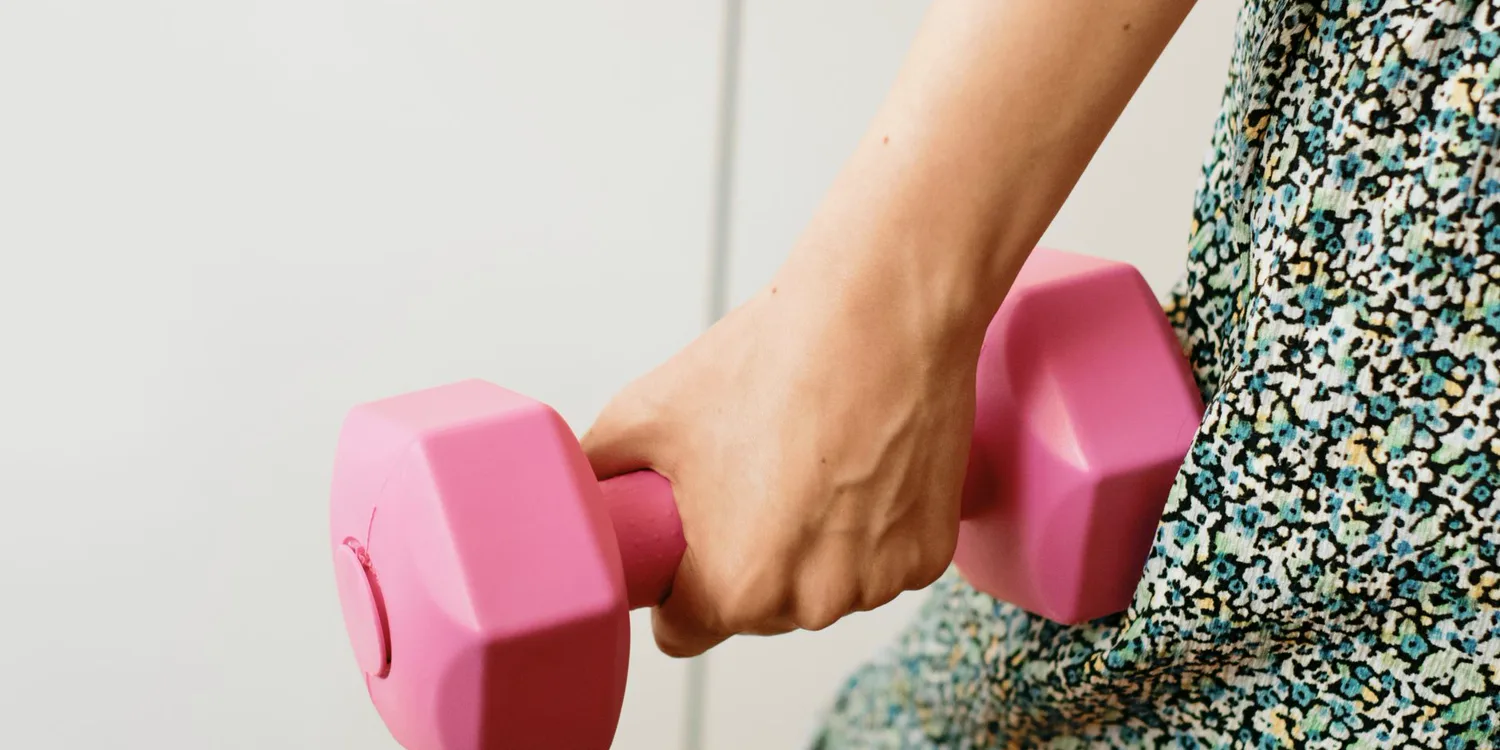
The 30-second arm curl test counts how many times you can curl a 5 lb (2.3 kg) dumbbell, seated, from a straight arm to a fully bent one in half a minute. For women aged 60 to 64, the middle half of scores runs from 13 to 19 curls, and that range slides to 10 to 16 by 80 to 84, in the Senior Fitness Test norms of Rikli and Jones (tabulated by Topend Sports). A count under the bottom of your band is below average. Enter yours below to see where it falls.
This is the upper-body partner of our 30-second chair stand test, from the same battery and built by the same team, so the two numbers belong together in a notebook. The steps, a worked example and what to do with a low count follow the calculator.
Check your count
Example: 11 curls at age 68
11 curls
For women aged 65 to 69, scores between the 25th and 75th percentiles run from 12 to 18 curls. Eleven is just under that range, which the Senior Fitness Test calls below average.
| Age | Below average | Average range | Above average |
|---|---|---|---|
| 60 to 64 | Under 13 | 13 to 19 | Over 19 |
| 65 to 69 | Under 12 | 12 to 18 | Over 18 |
| 70 to 74 | Under 12 | 12 to 17 | Over 17 |
| 75 to 79 | Under 11 | 11 to 17 | Over 17 |
| 80 to 84 | Under 10 | 10 to 16 | Over 16 |
| 85 to 89 | Under 10 | 10 to 15 | Over 15 |
| 90 to 94 | Under 8 | 8 to 13 | Over 13 |
A screening estimate from one count. It does not diagnose anything, and nothing you enter leaves this page.
How to do the test at home
You need a 5 lb dumbbell, a firm chair without arms and a timer on your phone. The steps follow the Senior Fitness Test protocol as Topend Sports sets it out:
- Sit towards the edge of the seat on the side of your stronger hand, back straight and feet flat on the floor.
- Hold the dumbbell in that hand with the arm hanging straight down beside the chair, palm facing your thigh.
- Tuck your upper arm against your side and curl the weight up, turning the palm to face the ceiling as it rises, until the elbow is fully bent.
- Lower it until the arm is straight again, turning the palm back towards you on the way down.
- Start the timer and repeat as many controlled curls as you can in 30 seconds.
A curl that stops short at the top or the bottom does not count, and letting the upper arm swing forward turns the move into a shoulder lift. A partner who rests a hand lightly on your upper arm will feel any swing at once, and can hold the timer and count for you. Warm up with a few slow curls and no weight first. Stop if you feel sharp pain in the shoulder or elbow. Arms that burn and slow down in the last ten seconds are what the test is meant to find.
Which weight to use
The women's tables were collected with a 5 lb dumbbell, which is 2.3 kg. Men take an 8 lb (3.6 kg) weight. An older American battery, the AAHPERD Functional Fitness Test, runs almost the same curl but gives women 4 lb (1.8 kg), so its tables cannot be swapped with these.
Shops outside the US mostly sell dumbbells in whole and half kilograms. A 2.5 kg dumbbell is 0.2 kg heavier than the test weight and a 2 kg one is 0.3 kg lighter. Either is fine for tracking your own progress if you use the same one every time. Against the age tables, a lighter weight flatters the count and a heavier one holds it back, by an amount nobody has published, so the calculator marks the result as approximate and a count close to a line should be read as borderline. If you are buying a first pair for training rather than testing, the dumbbell weight finder sizes them from a few simple moves.
Where the numbers come from
Roberta Rikli and Jessie Jones, kinesiologists at California State University, Fullerton, built the arm curl as one of six items in the Senior Fitness Test. Their norms come from 7,183 people aged 60 to 94 living in their own homes across 21 US states, published in the Journal of Aging and Physical Activity in 1999. For each five-year band, the average range in the table is where women between the 25th and 75th percentiles scored. Below it is below average and above it is the top quarter. Topend reports a test-retest reliability of about 0.81 from the original work, which means a second count on another day lands close to the first.
Two limits apply. The volunteers were American, mostly active, and tested more than 25 years ago. And the bands barely move between 70 and 89, so the table separates a weak arm from a fit one far better than it separates a 72-year-old from an 84-year-old. Use it to see roughly where you sit, then compare yourself with your own last count.
What the count actually measures
The name suggests arm strength, yet a study of 48 women who lived independently, average age 72, found the count barely related to the hardest single elbow bend they could produce on a laboratory dynamometer. It tracked how long their arm muscles could keep working (a correlation of 0.45) and their fitness on an exercise stress test (0.44) instead (Dunsky, Ayalon and Netz, Journal of Strength and Conditioning Research, 2011). The authors point out that 30 seconds of repeated curls has a real aerobic part.
So read the result as stamina in the arm: carrying bags in from the car, hanging out a wash, holding a grandchild for more than a minute. For peak strength, a hand dynamometer is the closer measure, and our grip strength test compares that reading with British norms for women from 35 to 90. If stamina is what you want to raise, the six-week muscular endurance plan trains it with lighter, higher-rep sets and uses this test as one of its three retest counts. In the health-related fitness check, the arm curl stands for muscular endurance, one of five components tested together at home.
A worked example
Take a woman of 68 who manages 11 curls with a 5 lb dumbbell. Her band is 65 to 69, where the average range is 12 to 18. Eleven falls one short of it, so the test files her as below average by the narrowest possible margin. Given the limits above, I'd treat that number as her starting point and retest in eight weeks.
Now a woman of 74 who manages 18 curls. Her band runs from 12 to 17, so she is past its top and in the top quarter for her age. Nothing needs fixing, and the count is worth keeping as a baseline she can hold on to over the next ten years.
If you are under 60
The published tables start at 60, and no reference table for this exact test covers women in their 40s and 50s. At 45 or 55 the count works as a personal baseline. Write it down with the date and the weight you used, train your upper body twice a week for eight weeks, then test again with the same dumbbell.
If you already pass 19, the top of the youngest band, I'd stop expecting a 5 lb weight to show much change. Track a heavier curl for 8 to 12 reps with the progression calculator instead.
What to do with your result
The NHS asks adults over 65 to do activities that strengthen the muscles on at least two days a week, working the legs, hips, back, abdomen, chest, shoulders and arms (NHS, physical activity guidelines for older adults). For the arms, three moves cover most of it: a curl for the front of the arm, a row for the back and shoulder blades, and a push-up against a wall or worktop for the chest and the back of the arm. Our arm exercises for women over 50 sets out those three with a shoulder press and two triceps moves for a full upper body session. The home workout for women over 50 includes all three with seated and supported versions, the resistance band guide does the same work without dumbbells, and sets, reps and progressive overload explains how much to do and when to make it harder.
A below-average count is a reason to train, and it diagnoses nothing. If everyday jobs that use your arms have become hard, or one arm has grown clearly weaker than the other, raise it with your GP. If you have a heart or blood pressure condition, go through our pre-exercise health check before you start lifting.
Testing again
Retest every six to eight weeks with the same weight, the same chair, the same arm and at the same time of day. I know of no published figure for the smallest change that matters on this test in women, so I'd count a gain of two curls or more as progress and a single extra curl as a better morning.
Log the count next to your chair stand result and your grip, if you measure it. The three take about five minutes between them and cover legs, arms and hands, and they belong with the other non-scale victories worth writing down every few weeks.
My take
I'd run this test straight after the chair stand test, with a few minutes' rest, since the chair is the same and the two counts make a fair pair. Get a 5 lb dumbbell if you can, because the tables only hold at that weight. If the count comes out low, I wouldn't spend eight weeks doing nothing but curls. The test rewards stamina in the arm, and two full-body sessions a week with rows, presses and carries build that while working everything else as well. Everything else we have on staying strong as you age is collected in our muscle, bone and balance guides.