Food and protein
High-protein snacks for women over 50
A 170 g pot of plain Greek yoghurt, two hard-boiled eggs, a small tin of tuna or a bowl of edamame each gives you 10 g of protein or more for under 200 calories. One such snack a day is often enough to close the gap between what three ordinary meals supply and what a woman over 50 needs.
Most snack lists online count anything with a little protein in it, so a few almonds or a rice cake with hummus end up next to a pot of cottage cheese. This page sets a floor of 10 g per snack, because a smaller amount barely moves a day's total. Every figure below was worked out from the US Department of Agriculture's FoodData Central database (the SR Legacy tables), for the portion named, and the calories and fibre come from the same entries.
Why a protein snack helps after 50
The US recommended intake of 0.8 g of protein per kilogram of body weight is the same at every adult age. An expert group convened by the European Union Geriatric Medicine Society, the PROT-AGE study group, argued that people over 65 should eat at least 1.0 to 1.2 g per kilogram, and more if they are active or ill (Bauer and colleagues, Journal of the American Medical Directors Association, 2013). No health authority sets a separate figure for women in their 50s, so this page applies the same range to the years either side of menopause, when muscle starts to slip.
For a woman of 65 kg, 1.0 to 1.2 g per kilogram comes to 65 to 78 g a day. Three meals of 25 g each would cover it, yet breakfast is where most people fall short. The Rowett Institute at the University of Aberdeen points out that Britons eat little protein in the morning and most of it in the evening meal, and it cites the Health ABC study, in which older adults eating about 1.1 g per kilogram lost 40% less muscle over three years than those eating the standard amount (Rowett Institute, Protein snackification, 2018). The extra it describes for a 70 kg person, about 25 g a day, is roughly a pot of cottage cheese.
That is the case for a snack: it is the easiest place to add 10 to 20 g without rebuilding your meals. Our daily protein calculator gives your own figure, and protein after menopause explains where the numbers come from and why muscle needs them.
15 snacks with at least 10 g of protein
The table runs from dairy and eggs through fish and meat to plant foods. The order is by food group, so read it as a menu. Portions are ordinary ones I chose so each snack crosses 10 g, and the numbers are rounded to whole grams and calories.
| Snack | Portion | Protein | Calories | Fibre |
|---|---|---|---|---|
| Plain low-fat Greek yoghurt | 170 g pot | Protein: 17 g | Calories: 124 | Fibre: 0 g |
| Cottage cheese, 2% fat | 150 g | Protein: 16 g | Calories: 122 | Fibre: 0 g |
| Skimmed milk | a 350 ml glass (360 g) | Protein: 12 g | Calories: 122 | Fibre: 0 g |
| Hard-boiled eggs | 2 eggs (100 g) | Protein: 13 g | Calories: 155 | Fibre: 0 g |
| Apple with cheddar | 150 g apple, 45 g cheddar | Protein: 11 g | Calories: 259 | Fibre: 4 g |
| Tuna on toast | 85 g tuna in water, 1 slice wheat toast | Protein: 25 g | Calories: 177 | Fibre: 1 g |
| Cold roast chicken breast | 60 g | Protein: 19 g | Calories: 99 | Fibre: 0 g |
| Turkey and mozzarella roll-ups | 60 g sliced turkey, 20 g mozzarella | Protein: 14 g | Calories: 123 | Fibre: 0 g |
| Smoked salmon on toast | 60 g salmon, 1 slice wheat toast | Protein: 14 g | Calories: 148 | Fibre: 1 g |
| Sardines in oil, drained | 90 g | Protein: 22 g | Calories: 187 | Fibre: 0 g |
| Edamame, shelled | 155 g bowl | Protein: 18 g | Calories: 188 | Fibre: 8 g |
| Firm tofu cubes | 100 g | Protein: 17 g | Calories: 144 | Fibre: 2 g |
| Roasted chickpeas | 120 g cooked, before any oil | Protein: 11 g | Calories: 197 | Fibre: 9 g |
| Peanut butter on toast | 2 tbsp (32 g) on 1 slice wheat toast | Protein: 11 g | Calories: 285 | Fibre: 3 g |
| Pumpkin seeds | 35 g | Protein: 11 g | Calories: 196 | Fibre: 2 g |
Source for every row: USDA FoodData Central, SR Legacy entries for each food, scaled to the portion. A slice of toast is counted as 25 to 30 g of bread.
Dairy and eggs
Greek yoghurt and cottage cheese are the leanest high-protein foods in the dairy aisle, and both keep in the fridge for days. The figures describe plain versions. Flavoured pots add sugar (the high-protein yoghurt in the trial further down held 20 g), so I would sweeten plain yoghurt with a handful of berries instead. A tall glass of skimmed milk is the snack people forget, and it suits anyone who does not feel like eating mid-afternoon.
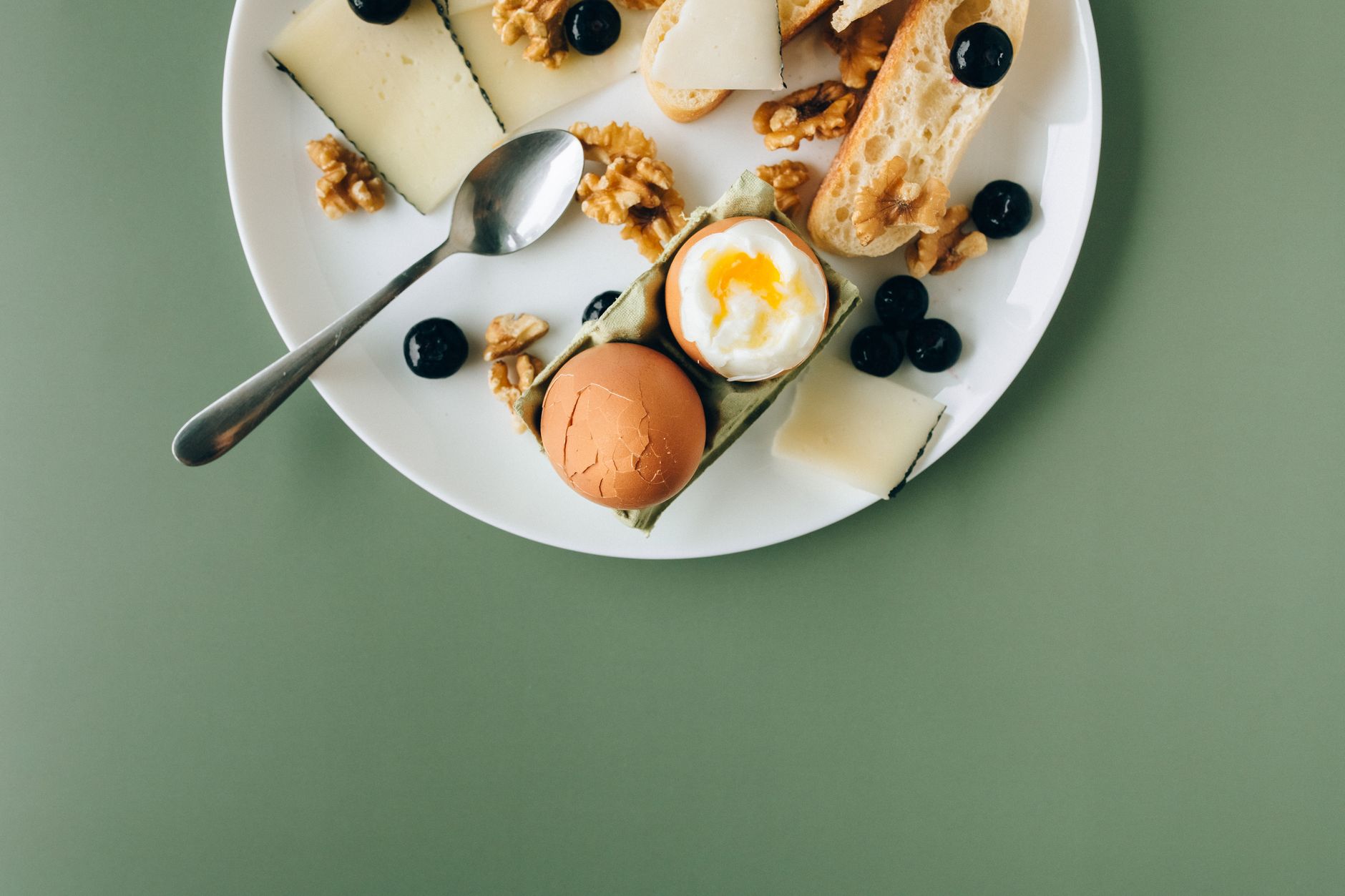
Two eggs boiled the night before are the cheapest item on the list. The apple and cheddar pairing is the only dairy snack here with fibre in it, and also the one with the most calories, since 45 g of cheddar alone comes to 181. Cheese, milk and yoghurt also bring calcium, which the calcium and vitamin D foods guide counts up portion by portion.
Fish and meat
Fish and lean poultry give the most protein for their calories of anything in the table. Sixty grams of leftover roast chicken, eaten cold from the fridge, gives 19 g for under 100 calories. Tuna piled on toast reaches 25 g, enough to count as a small meal, which makes it a good choice on a day when lunch was light. If that happens often, the high-protein lunch ideas lift the meal itself to about 25 g.
Sardines tinned with their soft bones are eaten whole, bones and all, so they add calcium to the protein. Smoked salmon and packaged turkey slices are cured, and cured meat and fish tend to be salty, so look at the salt line on the pack if your doctor has asked you to cut down. Jerky sits in the same group: the USDA entry for beef jerky lists 33 g of protein and 1,780 mg of sodium per 100 g, which makes it handy in a bag on a walk and a poor everyday habit.
Plant snacks
Edamame and roasted chickpeas are the two snacks on the list that bring real fibre with the protein: 8 and 9 g respectively, close to a third of the NHS's daily 30 g. A bag of frozen edamame cooks in a few minutes, and the beans are good warm with salt and lemon. Chickpeas from a tin, dried on a towel and roasted until crisp, keep in a jar for a couple of days. The calories in the table are counted before oil, so toss them in a teaspoon rather than a glug.
Firm tofu, cubed and baked or pan-fried, works as a savoury snack and, calorie for calorie, is the richest plant source in the table. Peanut butter on toast is filling and easy, though it costs nearly 300 calories for 11 g. Pumpkin seed kernels hold 30 g of protein per 100 g, and the 35 g in the table is a generous handful.
Nuts are where most snack lists overstate things. A 30 g handful of almonds gives only 6 g of protein. Reaching 10 g takes about 47 g, which costs 272 calories, so I treat nuts as a topping for yoghurt rather than a protein snack in their own right.
High-protein, low-calorie snacks for weight loss
If you are trying to lose weight, judge a snack by how much protein it gives for its calories. By that measure the chicken (about 19 g for every 100 calories), the tuna (14 g), Greek yoghurt (14 g), cottage cheese (13 g) and tofu (12 g) sit at the top. Apple with cheddar and peanut butter on toast sit at the bottom, at about 4 g for every 100 calories, because most of their energy comes from fat.
There is some evidence that the choice affects the next meal. In a small University of Missouri trial, 20 healthy women ate one of three 160-calorie afternoon snacks on separate days: a high-protein yoghurt with 14 g of protein, crackers or chocolate. After the yoghurt they were less hungry through the afternoon than after the chocolate, asked for dinner about 30 minutes later, and ate about 100 fewer calories at dinner than after the crackers or chocolate (Ortinau and colleagues, Nutrition Journal, 2014). The women were around 27, the study lasted single test days, and a yoghurt company's research institute paid for it, so treat it as a pointer for midlife women rather than proof.
Over months, the picture is less tidy. A 2024 meta-analysis of 49 trials found that eating protein before a meal reduced hunger and how much people ate at the meal, but the weight effects of high-protein diets tended to fade after six to twelve months (Anjom-Shoae and colleagues, Frontiers in Endocrinology, 2024). A snack is still food. A 150-calorie yoghurt added on top of everything else will slow weight loss, while the same yoghurt eaten in place of biscuits helps it. If you want a number for your daily calories, the calorie calculator for women over 50 gives one.
A protein snack after a workout
Older muscle needs a larger helping of protein than younger muscle to respond fully after exercise, around 0.40 g per kilogram in one sitting in a pooled analysis of older men, which is 26 g for a woman of 65 kg (Moore and colleagues, Journals of Gerontology, 2015). Of the fifteen, only the tuna reaches that alone. Pairing a Greek yoghurt with a glass of milk gives 29 g between them, and a tin of sardines on toast comes close as well.
Most women do not need a separate post-workout snack, because a meal follows the session within a couple of hours. A snack earns its place when that meal is further away. The full timing advice, with what to eat before a session and on an empty stomach, is in what to eat before and after strength training.
How a snack fits your daily target
Here is how it works for a woman of 65 kg aiming at 1.0 g per kilogram, or 65 g a day. Say her breakfast is toast with butter and a cup of tea with milk, about 10 g. Lunch is a cheese sandwich, about 18 g, and dinner a chicken stir-fry, about 30 g (the high-protein dinner ideas give twelve plates at that level). That comes to 58 g, a little under the target, and a mid-afternoon pot of Greek yoghurt takes her to 75 g.
A better long-term fix is to move protein into breakfast, because a meal of 25 to 30 g does more for muscle than the same grams spread thinly. The high-protein breakfast builder counts the grams for you, and the 7-day menopause meal plan shows a whole week with protein at every meal. A snack is the stopgap while those habits settle.
My take
I would keep two things in the fridge at all times: plain Greek yoghurt and a few boiled eggs. Between them they cover most afternoons for very little money or effort. On a training day with a late dinner, I would make tuna on toast the snack, because it is the one item here that reaches the post-workout amount alone. I would skip protein bars and treat nuts as an extra, because both cost a lot of calories for the protein they give. And I would only add a snack once breakfast is pulling its weight, since a better breakfast fixes the gap every day.
When to talk to your GP or a dietitian
If you have chronic kidney disease, ask before raising your protein: the PROT-AGE group itself says people with severe kidney disease who are not on dialysis may need to limit it. The same goes for anyone told to restrict salt, given how much is in cured fish, deli meat and jerky. A registered dietitian can fit snacks around diabetes, a food allergy or a vegan diet. More guides on eating for strength are under food and protein, including fibre and regular meals for energy to train.