Progression calculator
When to go heavier on dumbbells and machines
Type in the weight you lift, the reps you aim for and what your last two sessions gave you, and see whether to add, keep or drop, in a size you can actually pick up.
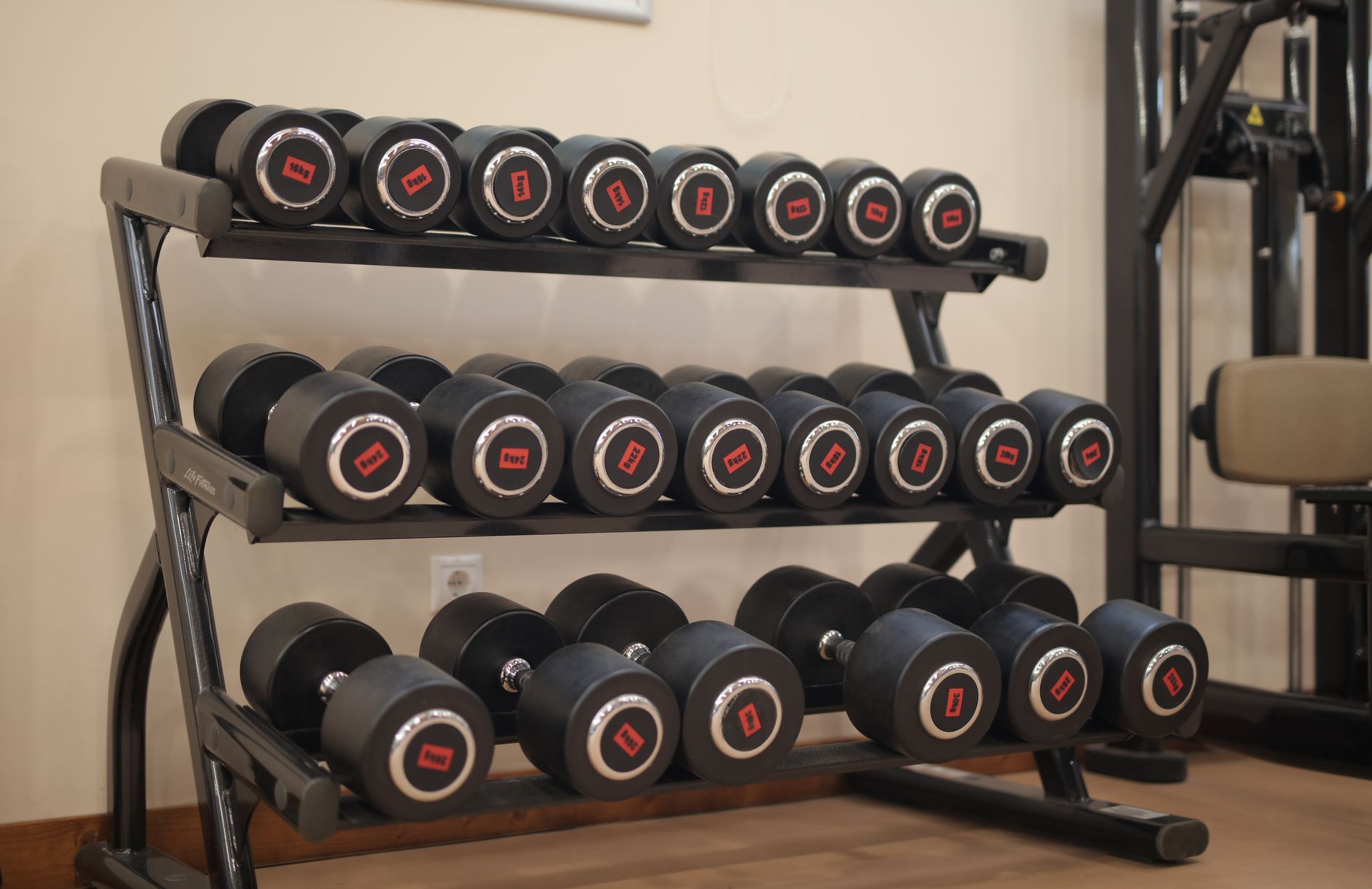
Go heavier when you can beat your target reps with good form in two sessions in a row. The American College of Sports Medicine's position stand on progression advises adding 2 to 10% to the load once you can do one or two reps more than your target (ACSM, Progression models in resistance training for healthy adults, 2009), and the coaching rule known as 2-for-2 asks for that margin twice before you change anything. The calculator below applies both to your own numbers and rounds the answer to a dumbbell you can buy or a plate the machine has.
Should you go heavier?
Example: a 4 kg dumbbell, target 10, last two sessions 12 and 11
Add: 5 kg
Both sessions went past your target of 10, so the next size up is due. 5 kg is 25% more than 4 kg, a bigger step than the 2 to 10% the ACSM suggests, because dumbbells this light come in whole kilos. If 5 kg gives you fewer than 8 good reps, go back to 4 kg for a week or two and add a set or slow the lowering before you try again. This meets the ACSM trigger. The stricter 2-for-2 rule would wait for one more session in which you reach 12.
2 to 10% of 4 kg is 0.1 to 0.4 kg. An estimate from your own log by the rules explained below, for healthy adults who already lift. Nothing you enter leaves this page.
What to enter
Work through one exercise at a time. Enter the weight you used, the reps you aim for in each set, and how many good reps you managed on the last set in each of your two most recent sessions. The last set counts most because your muscles are at their most tired by then. If you pass your target on it, you had room to spare on the earlier sets too.
A rep is good when it moves at the same speed and along the same path as the first one, with no swing or lean to get it up. End the set when you feel you could still manage about two more reps, the margin explained in our guide to sets, reps and progressive overload. If you always stop exactly on your target number, the calculator can only ever tell you to keep going as you are, so on the last set of the move you are checking, carry on to about two in reserve and write down what you reach.
For a machine, also enter the size of one step on its weight stack. Many stacks move in plates of 5 kg or 10 lb, and some have smaller plates at the top. For adjustable dumbbells, enter the smallest change your set allows, often 1 or 2.5 kg.
How the calculator decides
It gives one of four answers, from the two sessions you enter:
- Add when both sessions reached at least one rep over your target. That is the ACSM trigger of "one to two repetitions over the desired number", asked for twice so that one good day does not move you up.
- Keep when you are inside your range, or when only one of the two sessions passed the target. The answer says how close you are.
- Drop when both sessions came in three or more reps short. This rule is ours. The position stand says nothing about going down, so we chose a margin wide enough that one tired evening does not set it off.
- Hold when you tick the pain box. The calculator will not suggest more weight on a move that hurts.
The 2-for-2 rule comes from the National Strength and Conditioning Association's textbook, Essentials of Strength Training and Conditioning, and is taught as: add load when the final set beats the target by two or more reps in two consecutive sessions (a CSCS study guide's summary of the rule). It asks a little more than the ACSM wording does. When your log meets the looser trigger but falls short of 2-for-2, the answer says so, and you can hold off a little longer if you prefer.
Why two sessions in a row
A single strong session can come from a good night's sleep, an easy day at work or a grip that felt better than usual. Two strong sessions back to back are much harder to explain away. In perimenopause and menopause, sleep broken by night sweats can leave one session noticeably flatter than the last, which is a reason to judge your progress over more than one day. If your weeks have those dips, the strength week planner helps you place lifting days around them. The same logic runs in reverse: one poor session never sends the weight down on its own.
How much weight to add each week
There is no fixed weekly amount. The position stand ties each increase to what you can do, at 2 to 10% whenever you pass the trigger, and recommends training two to three days a week for beginners. At that pace a beginner may move up every week or two on some moves and stay on the same weight for a month on others. The National Institute on Aging names more weight, more sets, more repetitions or an extra training day as the ways muscles get stronger (NIA, Three types of exercise), so a week without a heavier dumbbell can still be a week of progress.
On light weights the percentage is tiny in kilos. 2 to 10% of a 4 kg dumbbell is 0.1 to 0.4 kg, less than the gap between any two fixed sizes. On a 60 kg leg press it is 1.2 to 6 kg, which one 5 kg plate covers. Coaching textbooks also quote fixed jumps of 1 to 2.5 kg for upper-body lifts and 2.5 to 5 kg for lower-body lifts, but those figures are written for barbells and trained athletes, far above the loads of a first year at home, so the calculator works from the percentage instead. If a plan you follow sets its loads as a share of your max, the one-rep max calculator estimates that figure from a set you already do.
When the next dumbbell is too big a jump
Fixed dumbbells under 10 kg usually go up a whole kilo at a time, and in pounds the steps from 3 to 5 to 8 lb are steeper still. Going from 3 kg to 4 kg adds a third to the load. If the new size gives you fewer reps than the bottom of your range, bridge the gap at the old weight for a week or two, using one of these:
- a third set, if you have been doing two
- a slower lowering phase, about three seconds down on every rep
- more reps past your target, up to around 15, before you try the heavier pair again
- the heavier dumbbell for your first set only, finishing the other sets with the lighter one
Pick one of these and keep the rest of the session the same, so you can tell what made the difference. The diagram of double progression in the sets and reps guide shows how reps climb at one weight and reset at the next.
On the machines
A weight stack makes the arithmetic easy and the steps coarse. One 5 kg plate on a lat pulldown set at 20 kg adds a quarter, while the same plate on a leg press set at 60 kg adds about 8%. Expect your legs to pass the trigger sooner and take each plate more easily, and your pulling and pressing moves to sit on one setting for longer. Many gym machines have a small add-on weight, a half plate that slides over the top of the stack or hangs on a peg beside it, and gym staff can show you where it is. Enter its size as the step and the calculator will use it.
Set the seat and pads the same way every session and note the settings in your log, because a change of seat height can look like a stall or a jump in strength. Our gym workout for women over 50 walks through setting up each of the common machines.
Three worked examples
A dumbbell shoulder press. She presses a pair of 3 kg dumbbells, aims for 10 reps, and managed 12 on the last set in both of her recent sessions. Both sessions are two over the target, which satisfies the ACSM trigger and 2-for-2 alike, so the answer is to add. The next pair is 4 kg, a third heavier. If 4 kg gives her 6 reps, she goes back to 3 kg for another week or two with a third set and tries again.
A leg press. The stack is set at 50 kg and moves in 5 kg plates. Her target is 10, and her last two sessions gave 11 and then 12. The calculator says add: 55 kg is 10% more, the top of the ACSM range. It also notes that the earlier session was only one rep over, so a lifter following 2-for-2 strictly would stay at 50 kg until the next workout confirms it.
A seated row machine. She moved the pin to 25 kg two weeks ago and has managed 7 and then 6 reps against a target of 10. Both sessions are three or more short, so the calculator suggests dropping back to 20 kg and building up again from there. A fortnight at a weight she controls will do more for her technique than two more weeks of grinding out six shaky reps.
When to stay put or go lighter
Muscle soreness a day or two after a harder session is expected, and our guide to how long muscle soreness lasts explains what is normal. Pain in a joint during a rep, or pain that lasts, is a reason to stop adding to that move and get it looked at, which is why the pain box overrides everything else. After a break of a few weeks, start below where you left off: the article on losing muscle when you stop lifting sets out how far to step back for each length of gap. If you have been told your bone density is low, the same counting rules apply with technique ahead of load, and our page on exercise with osteoporosis covers which moves to adapt.
This calculator is for adults who already lift and have no medical reason to hold back. If you have a heart, joint or blood pressure condition, or have not exercised for a long time, start with our pre-exercise health check.
My take
I'd run the calculator once a week for each main move, the evening before a session, and leave it alone between sets. I'd hold presses and rows to the stricter 2-for-2 rule, because the dumbbell steps there are the steepest share of the load, and I'd accept the looser ACSM trigger on leg machines, where one plate is a small slice of the total. And I would treat a drop as routine maintenance. Dropping to the next dumbbell down for a fortnight costs far less than months of ugly reps at a weight you are not ready for.
Where to go next
If you have not picked your first weights yet, the dumbbell weight finder turns one test set into a starting size for each move. The 4-week strength plan sets out what to do on each training day, and the principles of strength training after 40 explains why progression slows after the first few months. Every guide on lifting sits under strength training.