Strength training
Squats for women over 50
Start with the NHS sit-to-stand from a chair, move on to mini-squats holding the chair back, then partial squats at a kitchen counter or wall. Add one dumbbell held at your chest only when those feel steady and your knees are quiet the next morning.
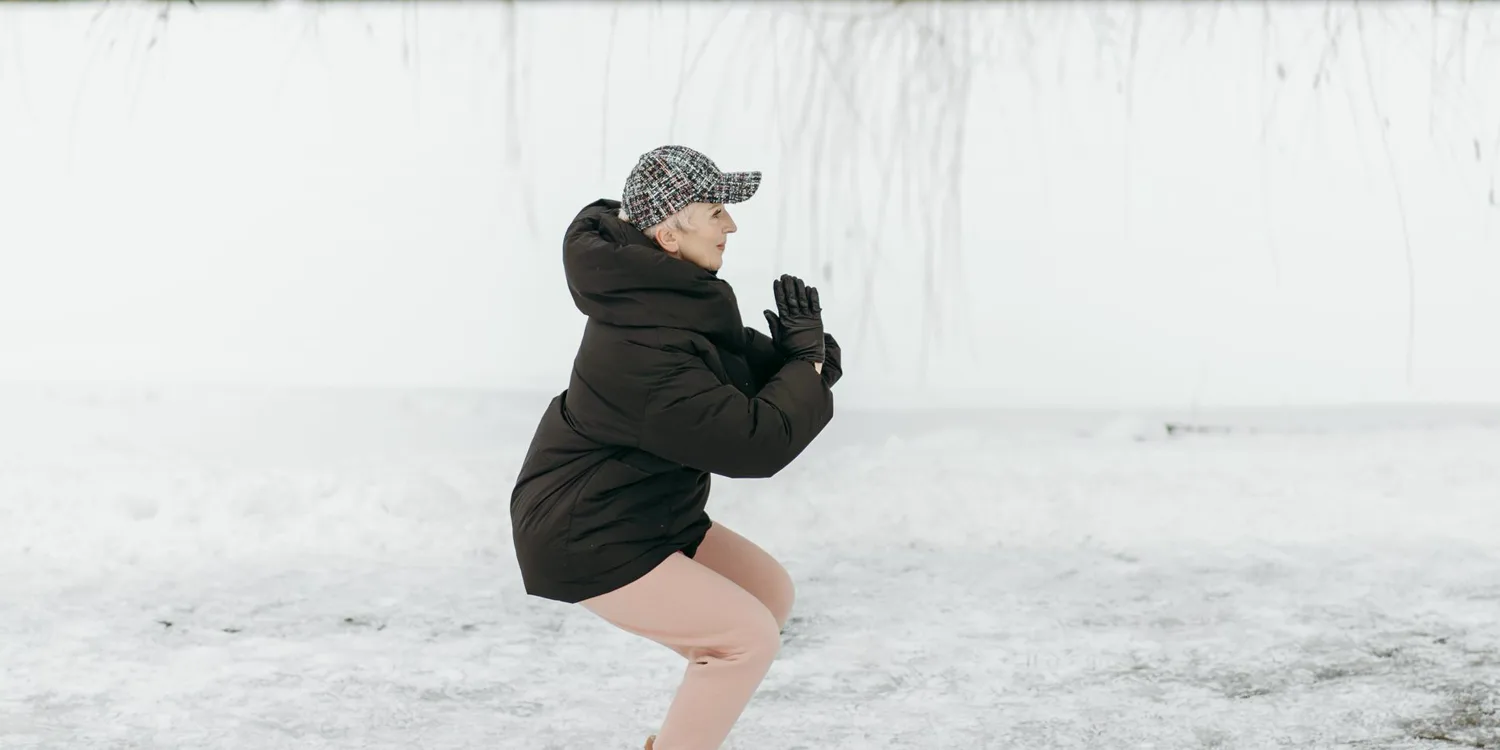
The squat turns up in almost every strength plan on this site, from the four-minute daily strength routine to the lower body workout for women over 50. This page teaches it from the ground up, in four steps you can take at home with a chair, a counter and later one dumbbell. It is the same leg strength the 30-second chair stand test measures, so that test is how you will know it is working.
Why squats belong in a menopause strength plan
Getting up from a low sofa, climbing stairs with shopping, lifting yourself off the floor after gardening: each of these is a squat with a different name. The US National Institute on Aging (NIA) lists squats among the moves that strengthen muscle using your own body weight, and MedlinePlus notes that many exercises for the legs, hips and lower back also improve balance.
Bone is the other reason. The National Institute of Arthritis and Musculoskeletal and Skin Diseases says resistance training puts stress on bones, which can strengthen the bones along with the muscles. The American Academy of Orthopaedic Surgeons' OrthoInfo page goes further and names squats, with deadlifts and the farmer's carry, as moves that carry weight and can benefit the hips and spine.
Before you squat: clearance and setup
The NHS advice for older adults is to speak to a GP first if you have not exercised for some time, or if you have medical conditions or concerns, and MedlinePlus says to talk to your provider before any new programme. The pre-exercise health check for women over 40 lists what to raise at that appointment.
The chair matters more than people expect. The NHS strength exercises page asks for a solid, stable chair with no wheels that will not slip on the floor, low enough that you sit with feet flat and knees at right angles, and with no arms, because arms get in the way of the movement.
Two habits from the National Institute on Aging apply to every step below. Keep a sturdy chair, a wall or another person within reach for support. Breathe out as you stand up, breathe in as you lower, and never hold your breath. Its advice also says not to lock your knees straight at the top, so finish each rep standing tall with the knees soft.
Step 1: Sit-to-stand from a chair
This is the box squat to a chair in its first form, and it is the first move in the NHS home strength series.
- Sit on the front edge of the chair with your feet hip-width apart.
- Lean forward a little from the hips.
- Stand up slowly, pushing through your legs rather than your arms.
- Sit back down as slowly as you can. Your hands can hover over the seat to guide you, but the legs do the work.
The NHS suggests five slow repetitions to begin with, then more over time. The slow lowering is the hard part, and the part people rush. If standing up without your hands is not possible yet, the Veterans Health Library knee exercise sheet suggests a firm pillow or folded blanket on the seat, which raises it and shortens the range.
The same sheet gives the harder version. Lower until your bottom just touches the chair, pause without sitting down, and push back up. That tap-and-rise is the box squat most trainers mean, and it is where step 1 ends.
Step 2: Chair-supported mini-squats
Turn the chair round. In the NHS mini-squat you stand behind it with your hands on its back for balance and your feet hip-width apart. Bend your knees slowly only as far as is comfortable, with the knees pointing forwards over your toes, then straighten up to standing. The NHS starts at five.
Without a seat underneath, your legs hold you the whole way, so this asks more of them than step 1 even at a shallow depth. For volume, one set of 8 to 12 repetitions of each exercise is effective according to the NIA, taken to the point where another repetition would be difficult. Build from five towards that range before you go deeper or move on.
The NHS series is meant to be done at least twice a week, with repetitions added gradually. Pair the mini-squat with the other moves in a short session, or use the strength session builder to get a full-body plan around it.
Step 3: Wall or counter-supported partial squats
What most people call a wall squat sits between the mini-squat and a free squat. The Chartered Society of Physiotherapy's knee pain exercises describe a semi-squat holding a kitchen counter. Keep your back straight and your hips above the level of your knees, and lower slowly without leaning forward. Your heels stay on the floor the whole time.
You can do the same move with your back near a wall, so you have something behind you if you tip. OrthoInfo lists chair and corner-wall exercises as a safer choice for people whose ordinary lifting would bend the spine, which makes a corner a good place for step 3 if your bones are a concern. Stop if you feel sharp pain in a knee or your back. The Veterans Health Library sheet says a little discomfort is normal, but any exercise that causes pain should stop.
Once 8 to 12 partial squats at the counter feel controlled, try letting go and holding your hands at your chest, with the chair still behind you as a target.
Step 4: Goblet squat with one dumbbell (optional)
Hand-held weights are on the NIA's list of strengthening options, and the goblet squat is the gentlest way to add one. Hold a single dumbbell upright against your chest with both hands, stand in front of your chair, and squat as in step 3 until your bottom brushes the seat. Then stand up and breathe out.
Start light. The dumbbell weight finder works out a first weight from what you can already lift, and the aim is still a set where the last repetitions feel hard while your form holds. I would keep the chair behind you at this stage, because it sets the same depth for every repetition and gives you somewhere to sit if a set goes wrong.
This step is optional. A woman who does steps 1 to 3 on two days a week, with more repetitions over time, is doing squats for women over 50 as the NHS describes them. The dumbbell is for when bodyweight has stopped feeling hard.
How to squat safely over 50
Frequency first. The NHS older adults guidance asks for activities that improve strength, balance and flexibility on at least two days a week. For strengthening, the NIA agrees and adds that you should not work the same muscle group two days running. Squatting on Tuesday and Friday, for example, satisfies both pieces of advice.
Effort next. The NHS adult guidelines say strength work brings health benefits when you do it to the point where you need a short rest before repeating. If you could do another ten without pausing, the set is too easy. For how many sets to work up to, see how many sets and reps to aim for.
Then change one thing at a time. Go deeper, or do more repetitions, or add weight, but never two in the same week. If something hurts afterwards, you then know which change to undo.
Squats with knee pain or arthritis
Knee osteoarthritis is no reason to drop the squat. The NICE osteoarthritis guideline asks clinicians to offer therapeutic exercise to everyone with osteoarthritis, including local muscle strengthening. It also tells them to warn that joint pain may rise when you start, and that regular exercise will help the joints even if it causes some pain or discomfort at first.
The practical rules come from physiotherapy advice. Pocket Physio suggests beginning with a mini-squat or a chair squat and lowering the seat a little only once a height has felt easy for a week. Pain on the way down means putting the cushion back. A knee that is sorer, stiffer or puffier the next day, or pain creeping up from week to week, means the last thing you changed was too much.
In practice, step 1 with a pillow and step 3 at a counter are the two to start with. The knee arthritis exercises for women over 50 page adds the other moves that sit alongside them.
Squats if you have osteoporosis
Resistance work loads bone, which is the point, and NIAMS advises talking to your provider before you start if you have osteoporosis or osteopenia. OrthoInfo says people with severe osteoporosis should avoid exercises that bend or twist the spine, and should take care lifting weights while standing upright to avoid compressing the spine.
For squats, that means a tall chest with the movement coming from the hips and knees, no rounding forward to reach a low seat, and a chair or corner wall for support. If you have had a fracture or a scan showing severe bone loss, ask your doctor or a physiotherapist to set the load and depth. More on this is in exercise if you have osteoporosis, and the numbers on your report are explained in bone density scan results.
My take
I'd start with steps 1 and 2 alone for the first month, on two days each week, and skip the dumbbell until then. Five slow sit-downs, taken until another one would be difficult, already meet the effort the NHS describes, and there is nothing to gain from rushing to a heavier version you cannot control.
I'd judge progress by a number rather than by how low you go in the mirror. Do the chair stand test now, write the number down, and repeat it every few weeks. If the count goes up, the squats are working. For the next move once your legs are stronger, the hip strengthening exercises and balance exercises over 50 pages build on the same muscles, and more plans sit under the strength training topic hub.
Sources
- NHS, strength exercises
- NHS, physical activity guidelines for older adults
- NHS, physical activity guidelines for adults aged 19 to 64
- National Institute on Aging, three types of exercise
- Veterans Health Library, sit-to-stand for the knee
- Chartered Society of Physiotherapy, exercises for knee pain
- NICE NG226, osteoarthritis recommendations
- OrthoInfo, exercise and bone health
- NIAMS, exercise for your bone health
- MedlinePlus, exercise and physical fitness