Muscle, bone and balance
Tai chi, yoga and Pilates: do they build muscle?
Yes, a little: the NHS counts all three as muscle-strengthening, and trials in older women show gains in leg, hip and trunk strength and in balance. Only tai chi has shown a small rise in bone density, and the load stops climbing once you know the moves, so most women gain more by keeping the class and adding weights or bands on two days.
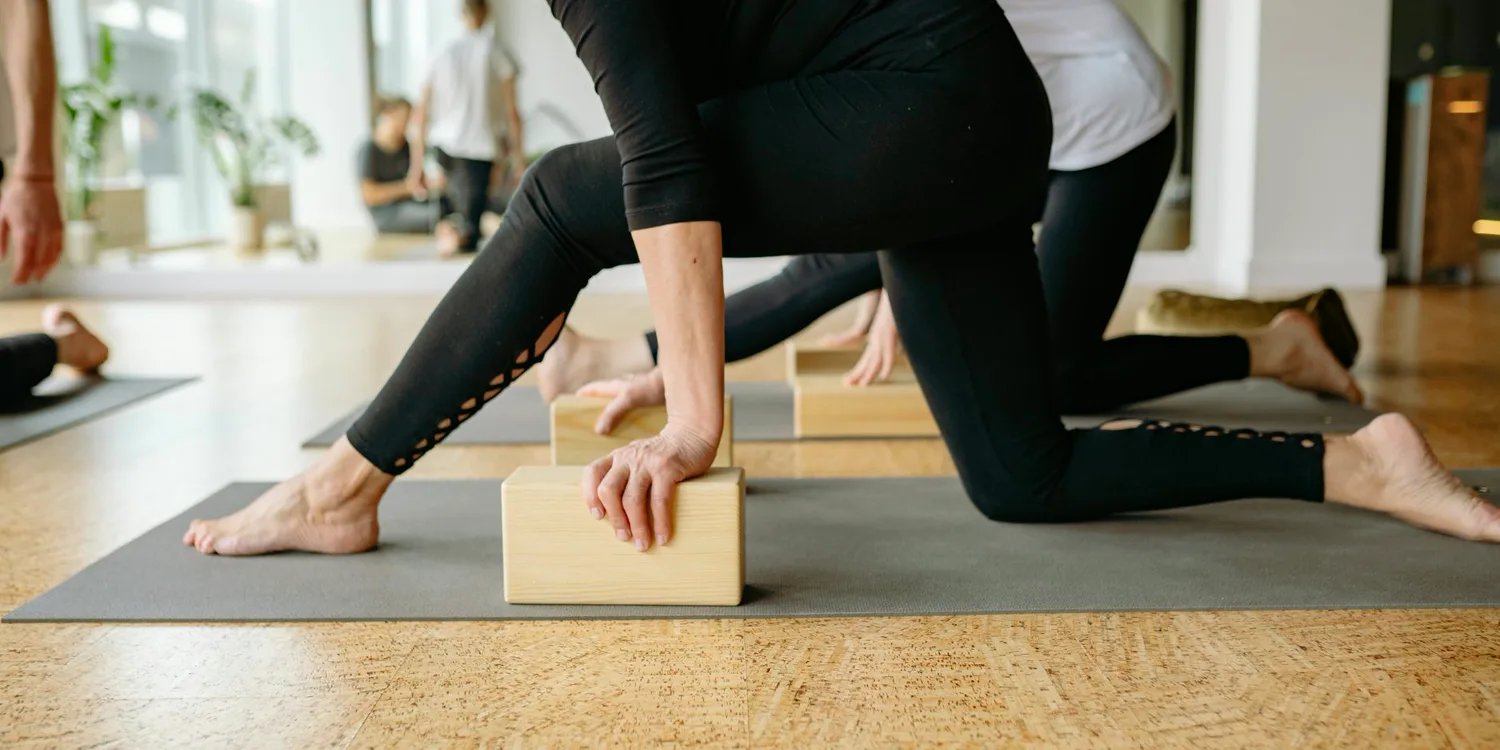
If you already go to a yoga class, a Pilates mat class or a tai chi group, you may have read that it counts towards your strength target and wondered whether that is the whole job done. The answer depends on what you want from it. For balance, the evidence for tai chi is better than for most kinds of exercise. For muscle and bone after menopause, the gains are real but modest, and they come from a level of effort that stops rising once you know the moves. This page sets out what the trials found and how to tell when it is time to add something heavier.
Does yoga count as strength training?
The NHS says adults should do strengthening activities that work all the major muscle groups (legs, hips, back, abdomen, chest, shoulders and arms) on at least two days a week. Its list of activities that qualify includes yoga, Pilates and tai chi, next to lifting weights, resistance bands, push-ups and heavy gardening (NHS, Physical activity guidelines for adults aged 19 to 64).
The same page adds a condition that is easy to miss: to get the benefit, you do strength exercises "to the point where you need a short rest before repeating the activity". A flowing class where every pose feels comfortable may not reach that point for your legs or arms. Holding chair pose until your thighs shake, or lowering slowly from plank, does. So yoga counts when it makes muscles work hard, and the same goes for tai chi done in a low stance.
Is Pilates strength training?
By the NHS measure it is, provided the class works your muscles until they need a breather. A mat class built on bridges, side leg lifts, the plank and leg circles works the hips, thighs, back and abdomen hard. Chest and arms usually get less, unless the teacher brings in bands or press-up variations, so a core-heavy class may cover only part of the "all major muscle groups" the guidance asks for.
What trials in older women found for strength
The studies are small, and every one was run in women past menopause age. In a Brazilian trial, 32 women around 64 years old did Pilates or static stretching in two sessions a week for 12 weeks. The Pilates group got stronger at both the front and back of the thigh on every dynamometer test, with large effect sizes against the stretching group (1.15 for the knee extensors, 1.59 for the flexors) (Oliveira and colleagues, Journal of Bodywork and Movement Therapies, 2017). That is a better result for the quadriceps than tai chi managed in the review covered further down.
A Spanish trial put Pilates up against resistance training directly. Sixty women aged 60 to 80 were split into a Pilates group, a resistance group doing chair squats, lunges, rows and dumbbell presses, and a group that carried on as normal, with both exercise groups doing two one-hour classes weekly over 18 weeks. Pilates did best on holding strength at the hip and trunk, while the resistance group improved every measure of hip strength taken through movement. Neither group reported an injury (Carrasco-Poyatos and colleagues, PeerJ, 2019). Only 49 women finished, which is too few to call a winner.
Pilates and bone density
Here the evidence is thin. A 2021 meta-analysis pooled 11 studies of Pilates or yoga in 591 women aged 45 to 78 and found no significant change in bone mineral density against control groups, with an effect size of 0.07. The authors suggested that holding bone steady at an age when it is expected to fall could still count in its favour (Fernández-Rodríguez and colleagues, PLOS ONE, 2021). The Royal Osteoporosis Society says plainly that "we do not yet know for certain whether Pilates helps to strengthen bones", and points to strength exercise combined with impact work as the way to keep bones strong (Royal Osteoporosis Society, Pilates and osteoporosis).
Pilates moves to swap if your bones are thin
The same Royal Osteoporosis Society page asks for care with moves that curl the spine forward or twist it, especially when they are repeated, quick, uncontrolled or done holding a weight. Its advice is to keep the back straight and bend from the hips, the movement trainers call a hip hinge. It names these swaps:
- Roll down: a wall-supported roll down, or the Cat on hands and knees
- Curl up and oblique curl up: knee fold with abduction, diamond press, dart or star
- Roll up: single-leg stretch with a foam wedge behind you
- Rollover: spine curl
- Saw and spine stretch forward: spine stretch forward with a straight back
The society suggests showing its table to your teacher. A class that relies on roll-downs and curl-ups for most of its abdominal work can still suit you if the teacher is happy to swap them.
Pilates or weights after 50?
Both count, and they train different things. Pilates builds holding strength around the trunk and hips and helps balance, with low strain on joints. Dumbbells, machines and bands can be made heavier in small steps for years, which is what bone responds to, as the LIFTMOR trial below shows. If your bone density is normal and you love your class, Pilates can be one of your two strength days. If a scan has shown osteopenia or osteoporosis, I would make sure at least one of the two days involves lifting something you can make heavier.
What the trials show for muscle strength
For yoga, the clearest summary comes from a University of Edinburgh review of 22 randomised trials in adults with an average age of 60 or over, recruited without any particular illness. Compared with doing nothing new, yoga improved balance (effect size 0.7), lower body flexibility (0.5) and lower limb strength (0.45). Compared with active controls such as walking or chair aerobics, yoga still came out ahead on lower limb strength (0.49) (Sivaramakrishnan and colleagues, International Journal of Behavioral Nutrition and Physical Activity, 2019). An effect size around 0.5 is usually read as moderate. The trials mostly measured strength with chair stands and similar tests, so they show better function in everyday movement more than bigger muscles.
Tai chi has a more mixed record. A 2021 meta-analysis of 25 trials in people over 60 found that tai chi improved lower body strength overall, mostly measured with the 30-second chair stand. When the researchers looked at the knee muscles separately, tai chi strengthened the hamstrings at the back of the thigh but made no significant difference to the quadriceps at the front (Yang and colleagues, Evidence-Based Complementary and Alternative Medicine, 2021). The quadriceps are what lift you out of a chair and up the stairs, and they are the muscles squats and leg presses load most directly.
Neither review was limited to women around menopause, and many of the trials were small. They describe what an older beginner can expect from a class two or three times a week, which is a fair guide, though not a precise one.
Balance and falls: where tai chi is strongest
For staying on your feet, tai chi has stronger evidence. A Cochrane review of 108 trials in people over 60 found that tai chi lowered the rate of falls by 19% and the number of people who fell by 20%, the second figure rated high certainty (Sherrington and colleagues, Cochrane, 2019). Programmes that combined several types of exercise, usually balance and resistance work together, cut the rate of falls by about a third. Our guide to balance exercises over 50 covers the rest of that review and the moves you can do at home.
That matters for bone, too. A fracture after menopause usually needs two things: a bone that has thinned and a fall that puts force through it. Tai chi works mainly on the second.
Tai chi for bone density
A 2022 meta-analysis from Chengdu University of Traditional Chinese Medicine pooled 24 randomised trials of tai chi in postmenopausal women. Compared with no exercise, tai chi raised bone mineral density at the lumbar spine and the femoral neck of the hip by about 0.04 g/cm² on average, with low certainty, and practice for longer than six months did more than shorter programmes. Tai chi did no better than other exercise, and most of the trials were run in China, many published as theses or abstracts (Liu and colleagues, Frontiers in Aging Neuroscience, 2022). The authors put the effect down to the half-squats and weight shifts in the form, which load the hips and spine more than you might expect from slow movement.
Heavy lifting has shown more, in a group that usually worries most about it. In the LIFTMOR trial, 101 postmenopausal women with low bone mass did supervised heavy lifts twice a week for eight months. Their lumbar spine density rose by 2.9% while it fell by 1.2% in a low-intensity home programme (Watson and colleagues, Journal of Bone and Mineral Research, 2018). That was one trial with a carefully coached programme, so take it as what is possible with expert supervision.
For yoga and bone there is less to go on. The UK consensus statement on exercise for osteoporosis, endorsed by the Royal Osteoporosis Society, puts it this way: resistance training ideally uses machines or weights, building up to the heaviest load you can lift 8 to 12 times, and where that is not an option, yoga or pilates, circuits, stair climbing and sit-to-stands "may be good muscle-strengthening alternatives". It lists tai chi, pilates and yoga separately as ways to improve strength and balance and lower the risk of falls (BMJ press release on Strong, steady and straight, 2022, published in the British Journal of Sports Medicine, doi 10.1136/bjsports-2021-104634). If your bone density scan showed osteopenia or osteoporosis, that ordering is the useful part: yoga and tai chi go alongside a resistance programme.
Yoga for menopause muscle: the ceiling
Muscle grows when it is asked to do a little more than last time, which is what progressive overload means. In yoga and tai chi the load is your own body weight. You can make a pose harder for a while by holding it longer, sinking lower or moving more slowly, and beginners gain strength quickly that way. After a few months most of the poses stop getting harder, while a dumbbell or a band can go up a step every few weeks for years.
The quadriceps, which tai chi trained least in the 2021 review, do most of the work of standing up and climbing stairs, and squats, step-ups and leg presses load them far more than a slow stance can. If you are worried about losing muscle with age, our guide to sarcopenia in women explains how it is measured.
When to add weights or bands
Signs that your yoga, Pilates or tai chi has become maintenance:
- The hardest pose in the class no longer leaves you needing a rest
- Your score on the 30-second chair stand test has stopped rising over a couple of months
- A scan has shown low bone density, and you want the type of training with the most evidence behind it
- You are trying to change your shape or weight and want to keep muscle while you do
Adding weights does not mean dropping the class. Two short resistance sessions on other days, or straight after a gentle class, fit the NHS target and leave tai chi or yoga doing the balance work. If you do not want to join a gym, a home workout with no equipment or a set of resistance bands is a gentler first step.
Choosing poses if you have osteoporosis
The same consensus statement asks people with osteoporosis to avoid postures with a lot of forward bending of the spine, such as toe touches and curl-ups. Several standard yoga poses bend the spine forward in just that way, including seated and standing forward folds. Tell the teacher about your diagnosis and ask for upright or back-extension versions instead, the same approach as the Pilates swaps above. The statement also suggests spinal extension exercises for posture, and our page on exercise with osteoporosis sets out which moves to keep and which to adapt.
The US National Center for Complementary and Integrative Health notes that tai chi instructors are not licensed and that there is no national standard for certifying them (NCCIH, Tai chi: what you need to know). Ask a teacher how long they have taught older beginners or people with low bone density before you sign up.
What I would do
If you enjoy a weekly class, keep it. A session you look forward to is easier to keep up through menopause, and tai chi in particular earns its place through falls prevention. I'd judge whether the class is doing strength work by your chair stand score: if it is still climbing, the class is enough for now. Once it stalls, I would add two resistance sessions of 20 to 30 minutes on different days, built around a squat or sit-to-stand, a push, a pull and a carry, and raise the load a step when the last two repetitions stop feeling hard. On a day when you only have time for one thing and your symptoms are moderate or severe, the class is the easier choice and still counts. How to start strength training in menopause takes you through the first sessions, and the strength week planner helps you fit them around the class you already go to.
Before you add anything heavier, the pre-exercise health check lists the symptoms to raise with your GP first, such as chest pain, dizziness or a recent fracture. More guides on keeping bone and muscle are gathered under muscle, bone and balance.