Strength training
Arm exercises for women over 50
Six moves cover the backs of the arms, the shoulders and the upper back: the wall press-up, one-arm row, seated shoulder press, overhead triceps extension, triceps kickback and biceps curl. Twice a week with light dumbbells builds the muscle under the skin, while the fat on the upper arm goes down only as your whole body loses fat.
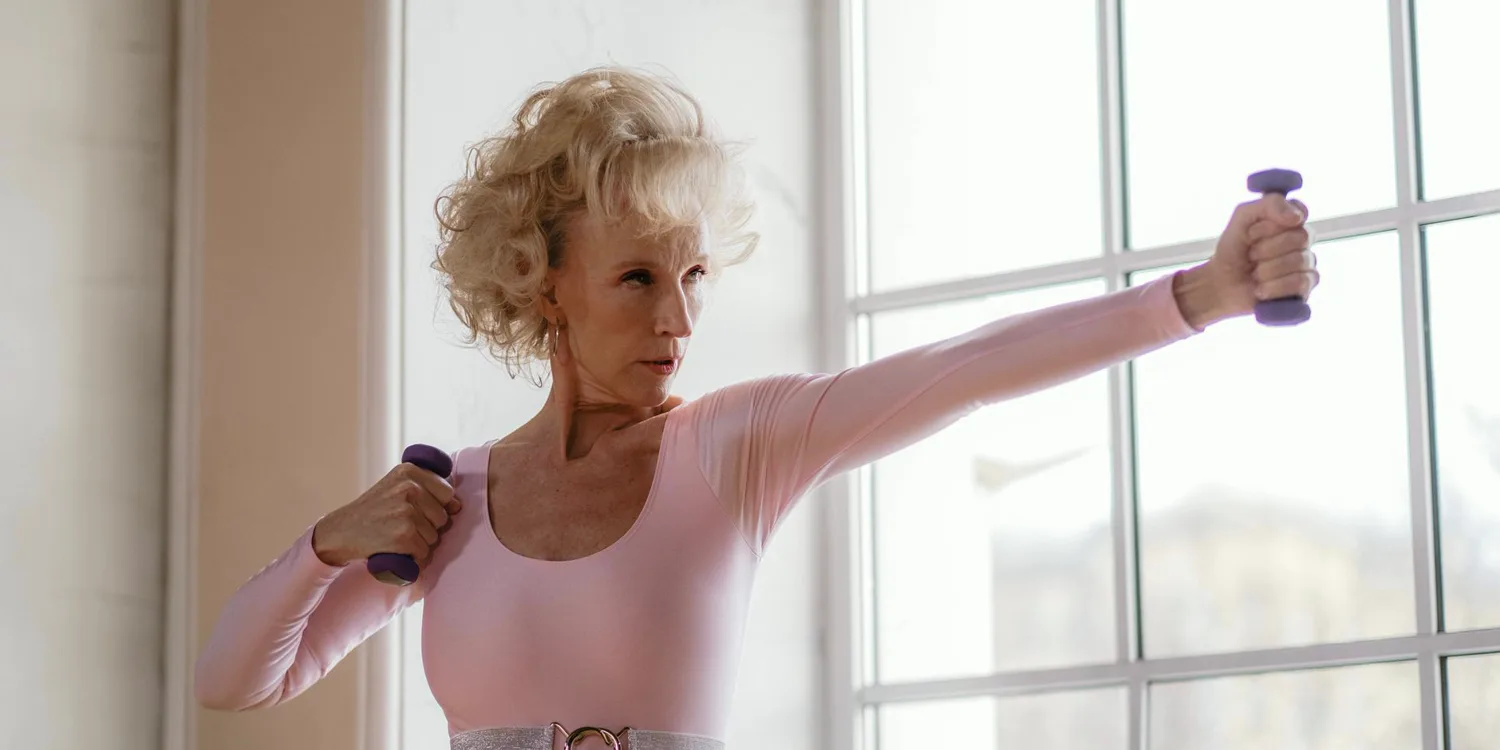
Most women who search for arm exercises after 50 are thinking about the soft area at the back of the upper arm, or about the shoulders that ache after lifting a suitcase into the overhead locker. Both come down to the same handful of muscles: the triceps along the back of the arm, the deltoids that cap the shoulder, and the upper back muscles that hold the shoulder blades in place. The NHS asks adults to work the chest, shoulders and arms along with the legs, hips, back and abdomen on at least two days a week (NHS physical activity guidelines for adults), and the six moves below do the upper half of that with a wall, a chair and a pair of dumbbells. To see where your arm strength sits before you begin, try the 30-second arm curl test and compare your count with the norms for your age.
Can exercise fix flabby arms over 50?
The softness on the back of the arm is a layer of fat over the triceps, and exercising the triceps does not melt the fat sitting on top of it.
The clearest test of this comes from a US study of 104 adults, 59 of them women, who trained only their non-dominant arm for 12 weeks under supervision (Kostek and colleagues, Medicine and Science in Sports and Exercise, 2007). MRI scans of both arms showed fat loss that was no different between the arm that trained and the arm that did nothing. Skinfold callipers picked up a local drop in the men's trained arm, but not in the women's, and the authors read the MRI, the more sensitive measure, as evidence that spot reduction does not happen.
Belly fat works the same way, and our page on menopause belly fat sets out the trial where six weeks of abdominal exercises changed no waist measurement at all. What arm training does change is the muscle underneath. A firmer triceps fills out the back of the arm, and stronger shoulders and upper back make carrying, reaching and pushing yourself up from a chair easier. For the fat itself, the levers are your whole-body energy balance and regular aerobic activity, which the guide to menopause weight gain works through.
Six arm and shoulder exercises for an upper body workout
Do them in the order below, after three or four minutes of marching on the spot with some shoulder rolls. The pushing and pulling moves come first, while you are fresh, and the small single-joint moves come last.
| Move | Main muscles | Start with |
|---|---|---|
| Wall press-up | Chest, front of shoulders, triceps | 1 set of 8 to 12 |
| One-arm row | Upper back, biceps | 1 set of 8 to 12 each arm |
| Seated shoulder press | Shoulders, triceps | 1 set of 8 to 12 |
| Overhead triceps extension | Triceps | 1 set of 8 to 12 |
| Triceps kickback | Triceps | 1 set of 8 to 12 each arm |
| Biceps curl | Front of the arm | 1 set of 8 to 12 |
1. Wall press-up
Stand at arm's length from a wall and put your hands flat on it at chest height, fingers pointing up. Keep your back straight and bend your elbows, close to your sides, so your chest moves towards the wall, then push back. The NHS strength routine suggests 3 sets of 5 to 10 (NHS strength exercises). Stepping your feet further from the wall makes it harder, and when 12 slow reps feel easy, move your hands to a kitchen worktop. Of all six, this one asks for no equipment and works the triceps, shoulders and chest together.
2. One-arm row
Put your left hand and left knee on a bench or the seat of a sturdy chair, right foot on the floor, back flat. Let a dumbbell hang from your right hand and pull it up towards your hip, elbow brushing your side, then lower it slowly. Finish one side before you swap. Rowing balances all the pushing in this list, and a strong upper back keeps the shoulders from rolling forward over a desk.
3. Seated shoulder press
Sit on a chair with a straight back and your feet flat. Hold a dumbbell in each hand at shoulder height, palms facing forward or facing each other, whichever your shoulders prefer. Push both weights up until your arms are almost straight, then lower to shoulder height. The National Institute on Aging advises against locking the elbows straight (NIA, Three types of exercise), so stop just short. Sitting with your back against the chair stops you leaning back to help the lift, and that lean is how most people end up straining the lower back during this press.
4. Overhead triceps extension
Still seated, hold one dumbbell in both hands by its end and lift it above your head. Keep your upper arms close to your ears and bend only at the elbows, so the weight lowers behind your head, then straighten your arms to lift it back up. This stretches the long head of the triceps, the part that runs down the back of the arm from the shoulder blade. If your shoulders will not let your arms sit by your ears without pain, swap it for the kickback and do two sets of that.
5. Triceps kickback
Take the same position as the row, one hand and knee on the bench. Lift the dumbbell until your upper arm is level with your body, elbow tucked in. Keep that upper arm still and straighten your elbow so the weight moves back towards your hip, then bend it again. You will use a much lighter dumbbell here than for the row, because the triceps moves it alone. With your free hand holding you up, the spine stays supported, which makes it a good triceps exercise if lifting overhead bothers your shoulders.
6. Biceps curl
Stand with feet hip-width apart, arms by your sides, a light weight in each hand. Bend your elbows slowly until the weights reach your shoulders, then lower them just as slowly. The NHS notes that filled water bottles will do and that you can curl sitting down. Keep your elbows pinned to your sides: once they drift forward, the shoulders are doing the lifting. The timed curl count uses this exact move to measure arm strength against other women your age, so it doubles as your progress check.
How heavy should the dumbbells be?
Heavy enough that the last two or three reps of a set are hard, with your form still tidy. The NIA puts the effort at the point where another repetition would be difficult, and it suggests beginners learn the movements without weights or with bands first. The two arm moves you lift most with, the row and the shoulder press, are both in our dumbbell weight finder, which works out a starting weight from one test set with anything you can weigh on the kitchen scales.
Expect each move to need a different weight. The row lets the big back muscles help, so it usually takes the heaviest dumbbell, and the finder's own worked example rows 4 kg and presses 3 kg. The kickback and the overhead extension, where the triceps works alone, take the lightest. If you can only buy one pair, choose the weight that suits the shoulder press, use two hands on one dumbbell for the extension, and slow the lowering on the moves where the pair feels too light. When 12 reps come easily on two sessions running, the progression calculator says how much to add, and how to bridge the jump from one dumbbell size to the next.
Shoulders, bones and joints
Shoulder discomfort is the most common reason women drop arm work, and it usually comes from pressing or extending overhead. Lower the press to a range that stays comfortable, keep the elbows a little in front of your body instead of flared out to the sides, and lean on the kickback for the triceps until overhead work feels easy. Sharp pain, pain that lasts into the next day, or a shoulder that will not lift your arm above shoulder height is a reason to see your GP or a physiotherapist before you carry on.
If a scan has shown low bone density, these moves share an advantage: the spine stays upright or rests on a hand, and none of them asks you to round your spine forward under a load, the pattern the Royal Osteoporosis Society asks people with weak bones to avoid (Royal Osteoporosis Society, How to exercise safely for bones). Keep your back flat in the row and kickback position and the same holds there. Our guide to exercise with osteoporosis lists the movements to adapt. If you are new to exercise or have a heart or blood pressure condition, go through the pre-exercise health check first. Whatever your health, the NIA asks you to breathe out during the effort and in as you relax, never holding your breath through a rep.
Fitting the moves into your week
Two sessions a week with at least a day between them covers the NHS target, and the NIA advises against working the same muscles two days running. The NIA also notes that one set of 8 to 12 of each exercise is effective and two or three sets may work better once you are used to it. All six arm moves take about 15 minutes for one set. Add the legs with a goblet squat or the sit-to-stand from the home workout for women over 50 and you have a whole-body session in under half an hour.
Bands work for every move here if dumbbells are not to hand. The resistance band exercises page shows the row, the chest press and the pull-apart, and a band looped under one foot replaces the dumbbell for the curl and the overhead extension. If you want a structure to follow, the 4-week strength plan adds sets week by week, and sets and reps for beginners explains how hard each set should feel.
My take
I'd start with three of the six: the wall press-up, the row and the kickback, because between them they work the backs of the arms, the shoulders and the upper back with the spine always supported. Once those feel steady, around the third week, I'd add the seated press and the curl, and keep the overhead extension for later, as it is the move shoulders most often object to.
I'd also take the arm curl test before the first session and again after six weeks. The number of curls you can do is a far better guide to whether this is working than the mirror, which changes slowly and mostly with your overall body fat.