Food and protein
High-protein foods list, by the gram
Thirty-three everyday foods with the protein in a normal serving and per 100 calories, from the USDA database. Sort them, filter to vegetarian or vegan, and set your own target for a meal.
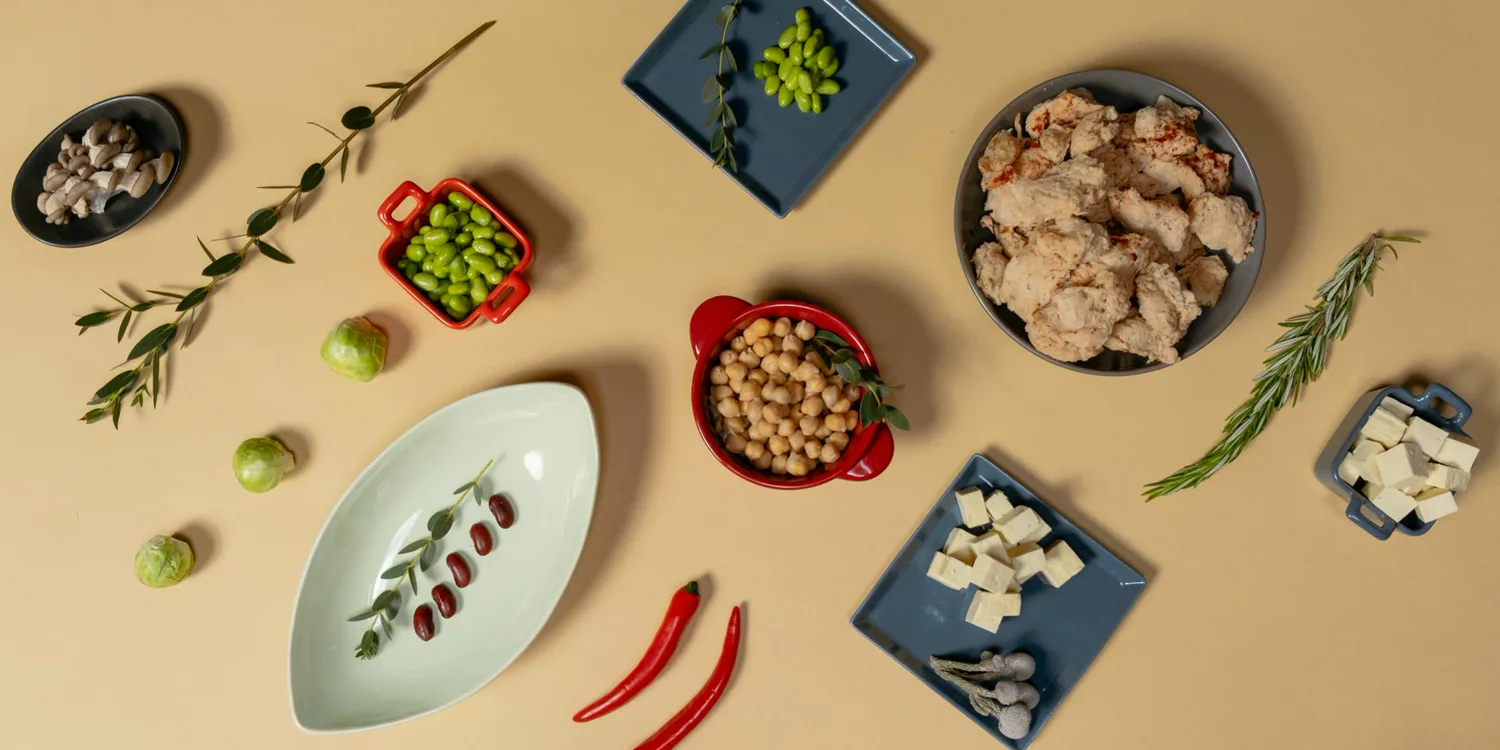
The foods with the most protein in a normal serving are fish, poultry, lean meat and firm tofu: a 140 g fillet of cod, 100 g of roast chicken breast or a 150 g block of firm tofu each give between 26 and 32 g, by the figures in USDA FoodData Central. That is enough for one meal on its own, since researchers propose about 25 to 30 g a meal for ageing muscle. Greek yoghurt, cottage cheese, lentils, edamame and eggs give 12 to 18 g a serving, and need a second food beside them. The table below lists 33 foods. Sort it by grams per portion or by grams per 100 calories, and narrow it to vegetarian or vegan foods.
Sort the protein foods
Pick which foods to show and how to order them. Grams are for the portion in the second column.
All 33 foods, most protein per portion first
8 of the 33 reach 25 g in one portion: cod, chicken breast, salmon, turkey mince, pork tenderloin, firm tofu, lean beef patty and tuna in water. The last column shows how many portions of each food make 25 g.
Columns: protein in grams per portion, calories per portion, grams of protein per 100 kcal, and portions needed for your meal target.
| Food | Portion | Protein | kcal | Per 100 kcal | For 25 g |
|---|---|---|---|---|---|
| Cod | 140 g fillet, cooked | 31.9 g | 147 | 21.7 g | 0.8 |
| Chicken breast | 100 g, roasted | 31.0 g | 165 | 18.8 g | 0.8 |
| Salmon | 140 g fillet, cooked | 30.9 g | 288 | 10.7 g | 0.8 |
| Turkey mince | 100 g, cooked | 27.4 g | 203 | 13.5 g | 0.9 |
| Pork tenderloin | 125 g, weighed raw | 26.3 g | 136 | 19.3 g | 1.0 |
| Firm tofu | 150 g | 26.0 g | 216 | 12.0 g | 1.0 |
| Lean beef patty | 100 g, grilled | 25.9 g | 250 | 10.4 g | 1.0 |
| Tuna in water | 100 g, drained | 25.5 g | 116 | 22.0 g | 1.0 |
| Prawns | 100 g, cooked | 24.0 g | 99 | 24.2 g | 1.0 |
| Chicken thigh | 100 g, with skin | 23.3 g | 232 | 10.0 g | 1.1 |
| Sardines in oil | 90 g tin, drained | 22.1 g | 187 | 11.8 g | 1.1 |
| Tempeh | 100 g | 20.3 g | 192 | 10.6 g | 1.2 |
| Lentils | 200 g, boiled | 18.0 g | 232 | 7.8 g | 1.4 |
| Edamame | 150 g | 17.9 g | 182 | 9.8 g | 1.4 |
| Greek yoghurt | 170 g pot, low fat | 16.9 g | 124 | 13.6 g | 1.5 |
| Cottage cheese | 150 g, 2% fat | 15.6 g | 122 | 12.8 g | 1.6 |
| Black beans | 170 g, boiled | 15.1 g | 224 | 6.7 g | 1.7 |
| Chickpeas | 160 g, boiled | 14.2 g | 262 | 5.4 g | 1.8 |
| Eggs | 2 large, boiled | 12.6 g | 155 | 8.1 g | 2.0 |
| Wholewheat pasta | 200 g, cooked | 12.0 g | 298 | 4.0 g | 2.1 |
| Beef jerky | 30 g | 10.0 g | 123 | 8.1 g | 2.5 |
| Smoked salmon | 50 g | 9.2 g | 59 | 15.6 g | 2.7 |
| Turkey slices | 60 g | 8.9 g | 64 | 14.0 g | 2.8 |
| Wholewheat bread | 2 slices, 70 g | 8.7 g | 176 | 4.9 g | 2.9 |
| Pumpkin seeds | 28 g | 8.5 g | 157 | 5.4 g | 2.9 |
| Skimmed milk | 250 g glass | 8.4 g | 85 | 9.9 g | 3.0 |
| Milk, 2% fat | 250 g glass | 8.3 g | 125 | 6.6 g | 3.0 |
| Quinoa | 185 g, cooked | 8.1 g | 222 | 3.7 g | 3.1 |
| Mozzarella | 30 g, part skim | 7.1 g | 89 | 8.1 g | 3.5 |
| Peanut butter | 32 g, 2 tablespoons | 7.1 g | 191 | 3.7 g | 3.5 |
| Cheddar | 30 g | 6.9 g | 121 | 5.7 g | 3.6 |
| Almonds | 28 g handful | 5.9 g | 162 | 3.7 g | 4.2 |
| Hummus | 60 g | 4.7 g | 142 | 3.3 g | 5.3 |
Average values from a food database. Brands differ, so for anything packaged the label on the pack is the better figure. Nothing you choose here leaves this page.
How the table is worked out
Every figure comes from the SR Legacy tables in USDA FoodData Central, the US Department of Agriculture's food composition database. It lists protein and energy per 100 g of each food. The portion column multiplies those by a serving you would put on a plate: a 140 g fish fillet, which is the portion size the NHS uses for fish (NHS, fish and shellfish), a 170 g pot of yoghurt, a cup of cooked beans, two eggs. Firm tofu, for example, is listed at 17.3 g of protein and 144 kcal per 100 g, so a 150 g block holds 26.0 g and 216 kcal.
Meat, fish, beans and grains are weighed cooked, because that is how they land on the plate, with one exception. The pork tenderloin is weighed raw, since that is the only lean figure the database gives. Cooking drives water out, so the same piece of meat holds more protein per 100 g once cooked.
Protein per 100 kcal is the grams of protein divided by the calories, times 100. It does not depend on portion size, which makes it the fairest way to compare a handful of almonds with a chicken breast. The last column divides your meal target by the grams in one portion, so a figure of 2.0 means two portions to reach it.
Why 25 to 30 g a meal is the target
Paddon-Jones and Rasmussen, at the University of Texas Medical Branch, reviewed the feeding studies on ageing muscle and proposed about 25 to 30 g of good-quality protein at each meal. Below roughly 20 g, older adults built less muscle protein after a meal than younger ones did, and far larger servings brought nothing extra (Paddon-Jones and Rasmussen, 2009). One of the authors had been paid by beef and dairy industry groups, which the paper discloses.
That is why the target box starts at 25. Only eight foods on the list get there in one portion, and seven of those eight are meat or fish. Everything else needs a partner: two eggs with a pot of Greek yoghurt, lentils with a little cheese, edamame stirred into a tofu stir-fry. The daily total still matters as well. The PROT-AGE group of geriatric specialists advised 1.0 to 1.2 g per kilogram of body weight a day for people over 65, more than the 0.8 g minimum set for adults generally (PROT-AGE Study Group, 2013). For a 65 kg woman, 78 g a day split three ways comes to 26 g a meal, which is where the two numbers meet.
A worked example: 25 g from four different foods
Sorting by grams per 100 kcal shows what the protein costs you in calories. Here is the same 25 g of protein from four foods:
- Chicken breast: about 81 g of meat and 133 kcal.
- Lentils: about 277 g cooked, a generous bowl, and 322 kcal, with the fibre that the chicken lacks.
- Peanut butter: about 113 g, or seven tablespoons, and 673 kcal.
- Almonds: about 118 g, four big handfuls, and 683 kcal.
Nobody eats seven tablespoons of peanut butter at a sitting, and that is the point of the column. Peanut butter, nuts, seeds, hummus and cheese are often called high-protein foods, and per 100 g they are. Per 100 calories, most of what they give you is fat, so they fit better as a topping than as the main event. If you are trying to lose weight, the foods near the top of the per-100-kcal sort (prawns, tuna, cod, pork tenderloin, chicken breast, turkey slices, Greek yoghurt) let you reach your meal target with the fewest calories. A 2024 review of 49 trials found that people who ate a protein preload before a meal felt less hungry and ate less at that meal (Anjom-Shoae and colleagues, 2024), though the same review saw the extra weight loss on high-protein diets shrink after 6 to 12 months.
Vegetarian and vegan high-protein foods
Filter to vegan and the list shortens to beans, soya, grains, nuts and seeds. Firm tofu stands apart: at 26 g for 150 g it is the only plant food that reaches 25 g in one ordinary serving. Tempeh comes next at about 20 g for 100 g, then edamame and lentils at around 18 g. Beans and chickpeas give 14 to 15 g a cup, along with 7 to 9 g of fibre per 100 g by the USDA figures, which no meat or dairy food on the list carries. The high-fibre foods list does the same sums for fibre and counts a day against 30 g.
Soya holds up for muscle as well. A 2018 meta-analysis of resistance-training trials found that soy protein supplements gave gains in strength and lean mass similar to those from animal protein (Messina and colleagues, 2018). Those trials gave people supplements rather than tofu dinners, so the finding is about soya protein itself, which is what tofu, tempeh and edamame are made of.
For a vegetarian who eats eggs and dairy, the gap closes quickly. A 170 g pot of plain Greek yoghurt has nearly 17 g, which is more than a cup of black beans, and 150 g of cottage cheese has almost 16 g. Two hard-boiled eggs give 12.6 g. A vegetarian lunch of 200 g of lentils and two eggs comes to about 31 g. A vegan one of 150 g of tofu with 75 g of edamame comes to about 35 g.
Grains are the weak spot. A cup of cooked quinoa, often sold as a protein food, has about 8 g, close to two slices of wholewheat bread. Both are worth eating for fibre, but neither carries a meal's protein on its own.
Turning the list into meals
MedlinePlus gives a kitchen rule that works with the table: an ounce of meat, fish or poultry, one egg, a quarter cup of tofu or half a cup of cooked beans each hold about 7 g of protein (MedlinePlus, protein in diet). Four of those make a meal near the target. The site's meal pages put the list on plates:
- the breakfast builder, where you tick the foods you already eat and see your total,
- high-protein lunch ideas you can pack for work,
- high-protein dinner ideas, five of them vegetarian,
- and high-protein snacks for the gap between them.
Fish also brings other things. The NHS advises at least two portions a week, one of them oily, such as salmon or sardines, and tinned sardines eaten with their soft bones add calcium (NHS, fish and shellfish). The guide to calcium and vitamin D from food covers that side of the plate.
My take
I would start with the grams-per-portion sort and pick one food from the top half for each meal, because that one item decides whether the plate reaches 25 g. I'd judge a day by whether every meal has such an anchor, which is easier to see than a running total. Everything else on the plate can then be chosen for taste and fibre. If weight is your worry, switch to the per-100-kcal sort and keep two or three of the leanest foods in the fridge: a tin of tuna, a tub of cottage cheese and a pack of cooked prawns cover most lunches. If you eat no meat, I'd build the week around firm tofu and Greek yoghurt, which do most of the work, and treat nuts, seeds and quinoa as extras rather than the protein of the meal.
Jerky is the one food I'd keep off the regular list. It has 10 g of protein in 30 g, but the USDA figure of 1,780 mg of sodium per 100 g puts over 500 mg of sodium in that small bag.
When to ask before you eat more protein
The PROT-AGE group named one clear exception: people with severe kidney disease who are not on dialysis may need to limit protein rather than raise it. If you have kidney problems, diabetes or another long-term condition, ask your GP or a registered dietitian what amount suits you before you add a portion to every meal. This page gives food figures only and no advice on protein powders or other supplements.
Protein builds muscle when the muscle has work to do. If you have not started lifting yet, how to start strength training during menopause covers the first sessions, and protein after menopause sets out the research behind the daily figures. Every guide on eating for strength is under food and protein.