One-rep max calculator
One-rep max calculator for women over 40
Choose the lift, type in a weight and how many good reps you got, and see your estimated one-rep max with the loads for strength, muscle and endurance work.
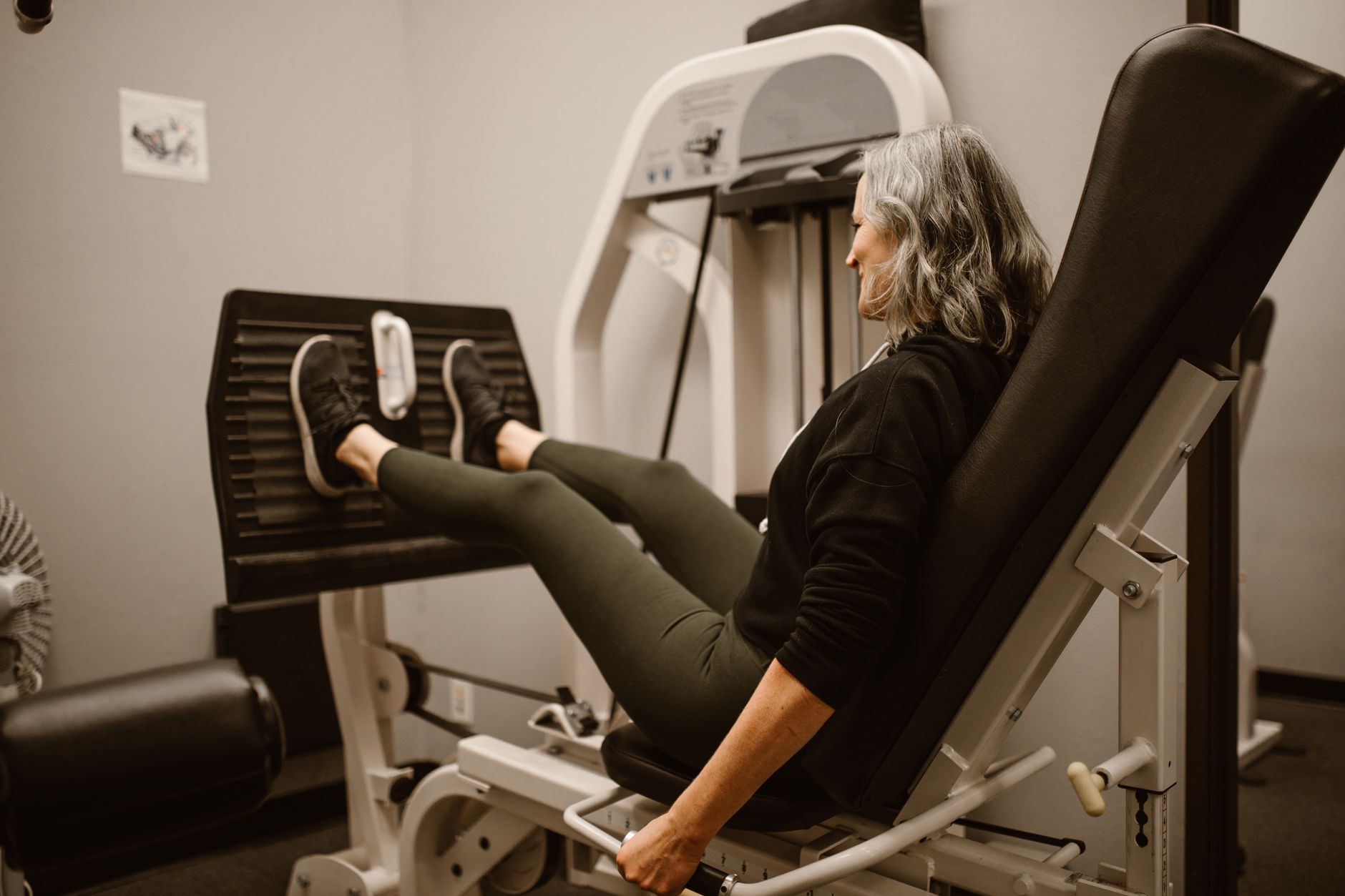
Your one-rep max is the heaviest weight you could lift once with good form, and you can estimate it from a lighter set of 3 to 12 reps instead of attempting it. It works the same way for a bench press, squat, deadlift, leg press or any other move where you can count clean reps. The calculator below uses the two most quoted formulas, Epley and Brzycki, and turns the answer into a percentage chart matched to the training ranges in the American College of Sports Medicine's position stand (ACSM, Progression models in resistance training for healthy adults, 2009). In adults over 60, estimates like these have missed the measured max by up to a fifth, so read the result as a starting figure.
Estimate your one-rep max
Example: 40 kg on the leg press for 10 reps
About 53.5 kg
Epley gives 53.5 kg and Brzycki gives 53.5 kg, so the two formulas agree here. If the estimate is off by as much as a fifth, the true figure lies somewhere between 42.5 and 64 kg.
Leg press machines differ in angle and in how much the sled itself weighs, so this figure holds only on the machine you used. For sets of 10, start near 40 kg.
| Share of max | Weight | Reps it allows, roughly |
|---|---|---|
| 85% | 45.5 kg | 6 |
| 80% | 42.5 kg | 8 |
| 75% | 40 kg | 10 |
| 70% | 37.5 kg | 12 |
| 60% | 32 kg | 15 or more |
| 50% | 26.5 kg | 15 or more |
| 40% | 21.5 kg | 15 or more |
An estimate by the Epley and Brzycki formulas, rounded to 0.5 kg. It is a guide for choosing loads, and nothing you enter leaves this page.
What to enter
Pick one exercise and one set from a normal session, done after your warm-up. Enter the weight you used and the number of good reps you completed. A good rep moves at the same speed and along the same path as your first one, with no lean, swing or bounce to finish it. The set should have been hard: at the end you could have managed one more rep at most. A set you stopped with five reps still in hand will make your max look smaller than it is, because the formulas assume you went close to your limit.
The closest estimates come from sets of 5 to 8 reps. The calculator accepts up to 12, since that is the top of the range most beginners train in, but past ten reps the two formulas start to pull apart and the margin of error grows. If your usual sets are 12 to 15 reps with a light dumbbell, add a little weight for one set of 6 to 8 on the day you want a figure.
How the calculator works it out
The Epley formula multiplies the weight by one plus the reps divided by 30. The Brzycki formula divides the weight by 1.0278 minus 0.0278 times the reps. Both assume that each extra rep you can do means the weight sits a little further below your max. A study that set these two formulas, and five others, against measured maxes printed them in the same form (Beia and colleagues, Sports, 2024).
For sets of under ten reps the two answers usually sit within a kilo or two of each other, and at exactly ten reps they meet. At 12 reps Epley comes out slightly lower. The calculator shows you both and builds the chart from their average, then rounds to the nearest half kilo or whole pound so the numbers match the plates and dumbbells you can actually use.
How accurate is it after 40?
Less accurate than the tidy numbers suggest. The formulas were mostly built on younger, trained lifters. The 2024 study above tested 40 well-trained adults with an average age of 73, all with osteopenia or osteoporosis, and summarised earlier work in untrained older adults and in postmenopausal women with low bone density, where predicted and measured maxes on the leg press differed by up to 20%. Even the equations the researchers built for each machine missed by 3.7% on average on the leg press and 6.9% on the leg curl, and they were most accurate when the set ran to 5 to 8 reps.
The fit also shifts from one exercise to the next. A 2024 study put nine formulas against measured maxes in 62 young women and 57 young men before and after 16 weeks of training. In the women, Brzycki was among the equations that matched the measured figure on the bench press and squat, while on the arm curl a different group of formulas came closer (Ribeiro and colleagues, International Journal of Strength and Conditioning, 2024). The deadlift was not one of the lifts tested.
That is why the result comes with a range of plus or minus a fifth. For choosing a training load the error matters less than it sounds: a weight that turns out a little light gives you extra reps, and the progression calculator then tells you when to move up. Where it does matter is any plan that asks you to lift close to 85% or more. Approach those loads from below, a step at a time, and let the reps you get be the judge.
One-rep max percentage chart
The reps column comes from the Brzycki formula run backwards, and the last column from the ACSM position stand. Below about 70% of your max the formulas were never built to predict reps, so the chart only says "15 or more" there.
| % of max | Reps, roughly | What the ACSM uses it for |
|---|---|---|
| 100% | 1 | A true max, the figure the calculator estimates |
| 90% | 4 | Heavy strength work for lifters with months or years of training |
| 85% | 6 | The heavy end, 1 to 6 reps, for trained lifters |
| 80% | 8 | Strength and muscle size, top of the beginner's 8 to 12 range |
| 75% | 10 | Strength and muscle size, middle of the beginner's range |
| 70% | 12 | Strength and muscle size, bottom of the beginner's range |
| 60% | 15 or more | Muscular endurance, or power when lifted fast |
| 50% | 15 or more | Muscular endurance, or power for the legs |
| 40% | 15 or more | The light end of endurance work |
What each range trains
The position stand recommends that beginners, defined as anyone with no training history or a break of several years, use loads they can lift 8 to 12 times. On the chart that is roughly 70 to 80% of your max. A summary of the stand by exercise physiologist Len Kravitz adds that loads of only 45 to 60% are enough to raise maximal strength in people who have not trained before (IDEA, Progression models in resistance training), which is reassuring if the 70% figure looks heavy for your first weeks.
Heavy work of 1 to 6 reps belongs to people with months or years of steady training behind them, according to the same stand, and it is the zone where an estimate that runs high can catch you out. Endurance work runs at 40 to 60% for more than 15 reps with rests under 90 seconds, and our muscular endurance workout builds a session around that range. Power training uses light loads moved fast, up to 60% for the legs and 30 to 60% for the arms, and the article on power training after 50 explains why that matters for stairs and getting up from a chair.
Why not just test your true max?
A real one-rep max test is a procedure: a graded warm-up, a few single lifts at rising weights with several minutes of rest between them, and a trained person standing by to take the weight. At home, with nobody to help and a dumbbell in each hand, there is little to gain from it, because the estimate gives you training loads that are close enough to start from.
There is also a specific risk for women with fragile bones. Clinicians in Heidelberg reported a 69-year-old woman, three months after treatment for breast cancer, who fractured a lumbar vertebra during a one-rep max test on the leg press. Scans afterwards found osteoporosis nobody had known about, and the authors suggested that studies of older or clinical groups switch to tests of several reps (Rosenberger and colleagues, Medicine, 2021). It is a single case, and supervised heavy lifting went well in the LIFTMOR trial described below, but it is a good reason to estimate rather than test if you have never had a bone density scan. Our page on exercise with osteoporosis covers what changes when you have the diagnosis.
Bench press and squat estimates
A bench press or squat calculator answers the same question, and the formulas stay the same from one lift to the next. For the bench press, enter the weight of the bar plus plates. On a chest press machine, enter the stack setting, and for a dumbbell bench press enter one dumbbell, which gives you a max for one dumbbell. A heavy dumbbell press is often limited by keeping the weights steady as much as by strength, so expect that figure to feel conservative.
For a barbell squat, enter the load on the bar. A bodyweight squat cannot be estimated this way, because your own body weight is not in the sum, so use a leg press or a goblet squat with a dumbbell held at your chest. Accuracy also varies by exercise: the 2024 study's leg press equation missed by less than its leg curl equation did. If a figure looks out of line with your other lifts, trust the reps you actually get over the number.
Deadlift and leg press estimates after 40
A deadlift or leg press calculator runs the same sum as the bench press. These two lifts deserve their own section because they move the heaviest weights most women ever handle, which makes a single all-out attempt on either the one to skip if your bones have never been scanned. The fracture in the case report above happened on a leg press, the machine many beginners see as the safe option because the seat holds you in place.
A set taken close to failure gives you what you need from a max without the risk of finding it. You choose a weight you expect to lift about eight times, warm up, and stop at the first rep that slows sharply or changes shape. That set tells you your training loads directly, it can be repeated in any normal session, and if the estimate runs high you find out with a weight you could already lift several times. The Heidelberg authors reached the same conclusion for older and clinical groups.
The deadlift: count only clean hinges
The deadlift is a hip hinge: the hips travel back, the back stays in one long line, and you stand up with the weight. Osteoporosis Canada's Too Fit To Fracture guidance includes hinge exercises in a basic strength programme. The same page tells people to bend with the hips and knees instead of the spine, and says those at high risk of fracture may need to limit bending while holding something heavy (Osteoporosis Canada, Too Fit To Fracture). For the calculator, that sets the rule for what counts. A rep where your back held its position is a good rep, and the rep where it began to round ends the set without counting.
Heavy deadlifting is still open to women after menopause. In the LIFTMOR trial, 101 women with low bone mass, aged 65 on average, lifted 5 sets of 5 at more than 85% of their max twice a week for eight months. Their lumbar spine bone density rose 2.9%, while it fell 1.2% in a group doing low-intensity exercise at home, and the only adverse event was a minor lower back spasm (Watson and colleagues, Journal of Bone and Mineral Research, 2018). The women were screened beforehand and every session was closely supervised, the conditions under which the authors report that result. If you train alone at home, the estimate is the safer way to reach the same loads.
Deadlift, 30 kg for 6 reps. The two formulas land at 36 and 34.8 kg, so the estimate rounds to 35.5 kg. Sets of 10 at 75% would sit near 26.5 kg. With a low bone density result she would stay nearer 70%, about 25 kg, for sets of 10 to 12 until a physiotherapist has watched her hinge, which is the kind of advice Osteoporosis Canada suggests getting on exercise choice and intensity.
The leg press: one machine, one figure
Leg press machines vary far more than barbells. Some sleds run at an angle and some slide flat, and the sled's own weight may or may not be part of the number on the stack. A max worked out on one machine does not transfer to another, so write the machine down next to the figure. On the plus side, the 2024 study of lifters in their seventies found its leg press equation missed by less than its leg curl equation, so the leg press is one of the more forgiving lifts to estimate from as long as you stay on the same machine. Our gym workout for women over 50 shows where the leg press fits in a full session.
Two worked examples
Leg press, 40 kg for 10 reps. Epley gives 40 × (1 + 10 ÷ 30), which is 53.3 kg. Brzycki gives 40 ÷ (1.0278 − 0.278), also 53.3 kg. Rounded, her estimated max is 53.5 kg. The chart puts 75% at 40 kg, the weight she already lifts ten times, which is a useful check that the numbers hang together. For sets of 8 she would try 42.5 kg, and for an endurance day 26.5 to 32 kg.
Bench press, a 20 kg bar for 8 reps. By Epley that is 25.3 kg and by Brzycki 24.8 kg, an average of about 25 kg. If the estimate is a fifth too generous her real max could be nearer 20 kg, so for sets of 10 she would start at 75% of the lower figure, 15 kg, which means a lighter bar or dumbbells, and build up from there.
Who should skip the numbers for now
If you have not lifted before, you do not need a one-rep max at all. The dumbbell weight finder picks a first weight for each move from one easy test set, which is the safer place to start. If you have a heart condition, high blood pressure, a joint that hurts when you load it or a recent fracture, go through our pre-exercise health check before you push any set close to its limit.
My take
I'd use this calculator for one thing: setting loads on the two or three big moves you do every week, such as a leg press, a row and a chest press. I'd take the figure from a set of 6 to 8 in a normal session, knock 10% off it for the first fortnight, and recalculate after four to six weeks. I would not chase the number itself. For most women starting after 40, adding reps and kilos session by session does more good than knowing exactly what you could lift once.
Where to go next
Our guide to sets and reps for beginners over 40 explains how many sets to do at each load, and our article on the principles of strength training after 40 shows how overload and progression fit together. Every guide on lifting sits under strength training.