Food for muscle, bone and heart
Fats after menopause: which ones to eat, and how much
After menopause, keep saturated fat under about 20 g a day (the NHS limit for women) and let olive or rapeseed oil, nuts, seeds and oily fish supply most of the rest. Aim for one portion of oily fish a week as the floor, because LDL cholesterol tends to jump in the year either side of your last period and swapping saturated fat for unsaturated fat is the food change with the best evidence behind it.
This page sets out how much fat a woman in or past menopause needs, which kinds to favour, and which foods carry them. It is written from public health guidance and published studies, each linked where it is used. It covers food only: supplements, fish oil capsules, HRT and cholesterol medicines are for you and your doctor to decide.
How much fat a day after menopause
Fat is not something to strip out of your diet. The NHS calls a small amount essential, because it supplies fatty acids the body cannot make and helps you absorb vitamins A, D and E (NHS, Fat: the facts). Vitamin D matters for bone after menopause, so a breakfast with no fat at all is a poor trade.
For the total, MedlinePlus suggests that no more than 25% to 30% of your daily calories come from fat (MedlinePlus, Facts about saturated fats). Every gram of fat carries 9 calories, against 4 for protein or carbohydrate. On a 1,800 calorie day, 30% works out at 540 calories, or about 60 g of fat. Our calorie calculator for women over 50 gives your own daily figure, and you can apply the same percentage to it.
Most women do not need to count total fat to the gram. The number worth knowing well is the saturated part.
The saturated fat limit for women
The UK government recommends that women eat no more than 20 g of saturated fat a day. US guidance sets the cap as a share of calories: under 10%, which MedlinePlus puts at 22 g on a 2,000 calorie diet. The two land close together. If your doctor has told you that your cholesterol is high or that you have heart disease, MedlinePlus notes they may ask you to go lower.
Twenty grams goes faster than most people expect. MedlinePlus gives these examples for a typical serving:
- 1 tablespoon of butter: 7 g
- A cheeseburger: 10 g
- A vanilla milkshake: 10 g
- An 8 oz (about 225 g) New York steak: 14 g
So a steak with a knob of butter on the potatoes uses the whole day's allowance in one meal. The NHS list of foods high in saturated fat adds fatty cuts of meat, sausages and pies, ghee and lard, hard cheese such as cheddar, cream and ice cream, biscuits, cakes, pastries, chocolate, and palm and coconut oil.
Reading a label for saturated fat
UK labels list it as "saturates". The NHS sets these bands per 100 g: more than 5 g is high, 1.5 g or less is low. A product sold as "lower fat" has only 30% less fat than the regular version, which can still leave it high, and the fat is sometimes replaced with sugar, so the calories barely move.
Why cholesterol makes fat matter more now
The Study of Women's Health Across the Nation (SWAN) followed more than 1,000 American women of several ethnic backgrounds through a natural menopause. Most heart risk markers changed slowly with age. Total cholesterol, LDL cholesterol and apolipoprotein B behaved differently: they rose sharply within the year before and after the final period, in every ethnic group (Matthews and colleagues, Journal of the American College of Cardiology, 2009). The authors' own conclusion was that lipids should be monitored in perimenopausal women.
An American Heart Association scientific statement in 2020 drew the same studies together and called midlife and the menopause transition "a critical window" for early prevention of heart disease (El Khoudary and colleagues, Circulation, 2020). Saturated fat is the part of the plate that pushes LDL up. The NHS and MedlinePlus both say so plainly, and that is why the guidance for this stage of life leans so hard on it.
Good fats for menopause: which ones to favour
Unsaturated fats come mostly from plants and fish. The NHS divides them into two groups.
Monounsaturated fats keep "good" HDL cholesterol steady while lowering LDL. You find them in olive oil, rapeseed oil and spreads made from these oils, avocados, and nuts such as almonds, brazils and peanuts.
Polyunsaturated fats also lower LDL. They come in two kinds, omega-6 and omega-3, and some of each are essential fats that only food can supply. Omega-6 is in rapeseed, corn and sunflower oil, and in walnuts, almonds and cashews. The NHS says most people already get enough of it. Omega-3 is the one most diets run short of.
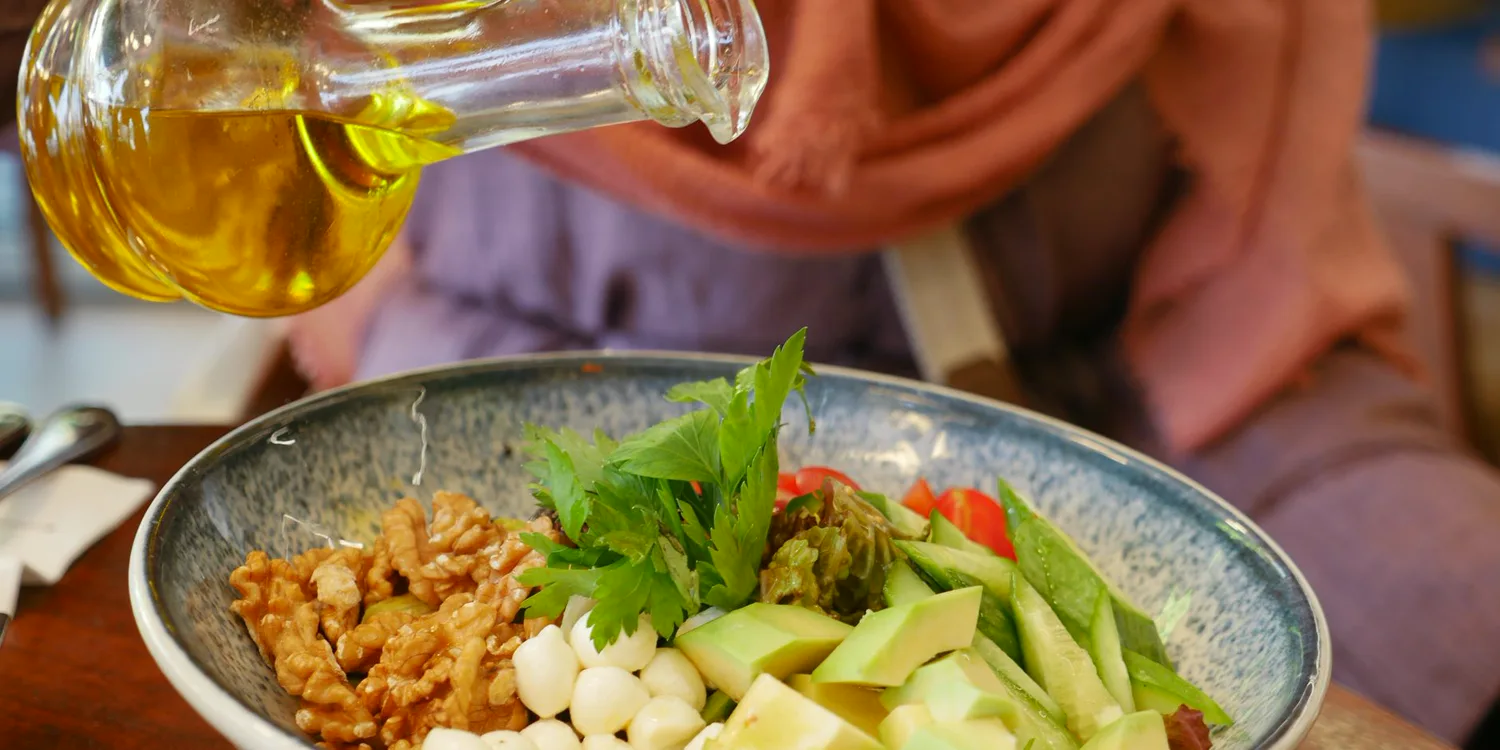
In a kitchen this means a bottle of olive or rapeseed oil for cooking and dressing in place of butter, a handful of unsalted nuts as a snack, and avocado or nut butter on toast. None of it needs a special shop. Our Mediterranean diet for menopause article covers the eating pattern built around these fats, including a Spanish trial where people ate olive oil freely for five years and did not gain weight.
Omega-3 foods in menopause
The richest source of long-chain omega-3 is oily fish. The NHS lists herring (kippers and bloaters among them), pilchards, salmon, sardines, sprats, trout and mackerel (NHS, Fish and shellfish). Fresh and tinned tuna do not count. Oysters and crab carry some long-chain omega-3, though much less than oily fish.
The NHS asks adults to eat at least two portions of fish a week, one of them oily, with a portion of around 140 g cooked. Its cap of two oily fish portions a week is written for girls and for women who have not been through the menopause, because pollutants in oily fish can build up and affect a future pregnancy. Women past menopause are not on that list.
Tinned sardines, pilchards and tinned salmon have a second use at this age. You eat their soft bones, which supply calcium and phosphorus, and oily fish is also a source of vitamin D. Our guide to calcium and vitamin D from food counts what those portions add up to.
Omega-3 without fish
For vegetarians the NHS names linseed (flaxseed) oil, rapeseed oil, walnuts and eggs enriched with omega-3. These carry the plant form of omega-3 rather than the long-chain form in fish. Whether you need a supplement on top is a conversation for your GP or pharmacist. The NHS fish page warns that fish liver oils are high in vitamin A and sets a combined limit of 1.5 mg a day from food and supplements.
Swap the fat rather than just cutting it
The strongest evidence on saturated fat comes from long trials. A Cochrane review pooled 15 randomised trials with 56,675 people who cut saturated fat for at least two years. Combined cardiovascular events (heart attacks, strokes and similar) fell by 17% (Hooper and colleagues, Cochrane Database of Systematic Reviews, 2020). In absolute terms, about 56 people had to cut saturated fat for roughly four years for one of them to avoid an event. The bigger the cut, the bigger the benefit. The same review found little or no effect on deaths, so the gain is fewer heart events rather than a longer life.
What replaced the saturated fat also mattered. Polyunsaturated fat and carbohydrate both looked useful as replacements, while the data on monounsaturated fat were too thin to judge. The review also found small drops in weight, LDL and total cholesterol and no sign of harm. In practice, the swap that has been tested is the NHS one: butter out, oil in, and fatty meat traded for fish, beans or skinless chicken.
Here is how that looks on a normal day:
- Toast with olive oil spread or nut butter in place of butter
- Cooking with rapeseed or olive oil, measured with a spoon
- Grilled mackerel or salmon one evening a week where you would have had sausages
- A small piece of strong cheese, grated so it goes further, in place of a thick slice of mild cheddar
- Greek yoghurt with walnuts and fruit in place of a pastry
Fat and menopause weight
All fats carry the same 9 calories per gram, olive oil included, so oil poured freely from the bottle adds up quickly. That is a reason to measure it with a spoon, and it is no reason to avoid it. MedlinePlus links weight gain mainly to high-fat foods such as pizza, baked goods and fried food, which bring sugar and refined flour along with the fat.
If you are trying to stop your waistline creeping up, the bigger levers are a modest calorie gap, protein at each meal and strength training. Our pages on menopause belly fat and how to prevent menopause weight gain cover those. Fat fits in by making meals satisfying, and the oily fish, nuts and yoghurt above also add protein, which helps protect muscle. The high-protein foods list sorts foods by protein per 100 calories if you want the leaner options.
My take
I would start with the butter. Swapping it for olive or rapeseed oil in cooking and on bread takes out a large share of most people's saturated fat with no new recipes to learn. Next I would book oily fish into the week, a tin of sardines on toast or a salmon fillet, because it brings omega-3, vitamin D and, from the tins, calcium. I would leave fat-free products on the shelf, since the guidance gives no reason to chase them and many swap fat for sugar. And because the SWAN data show LDL moving around the last period, I would ask the GP for a cholesterol check rather than guess.
When to talk to your doctor first
Ask your GP before making big changes if you already have high cholesterol, heart disease, diabetes or kidney disease, or if you take medicines that interact with diet. Your doctor may set a lower saturated fat limit than the one here. If you are thinking about a fish oil or omega-3 supplement, ask your GP or pharmacist whether it suits you alongside anything else you take. For the rest of the plate, see the 7-day menopause meal plan and the high-fibre foods list, or browse every guide under food and protein.